ChipApex | Global Electronic Components Supplier
SEARCH
Search Product
Search Post
— IC芯片 | 连接器 | 传感器 | 被动器件 —
Search productSearch post
— IC芯片 | 连接器 | 传感器 | 被动器件 —
Consult the customer manager about the wholesale price.
consultation hotline:86-132-6715-2157
email:[email protected]
Contact the product manager for consultation. One-stop consultation is available.
Do you want a lower wholesale price? Please send us your inquiry and we will reply immediately.
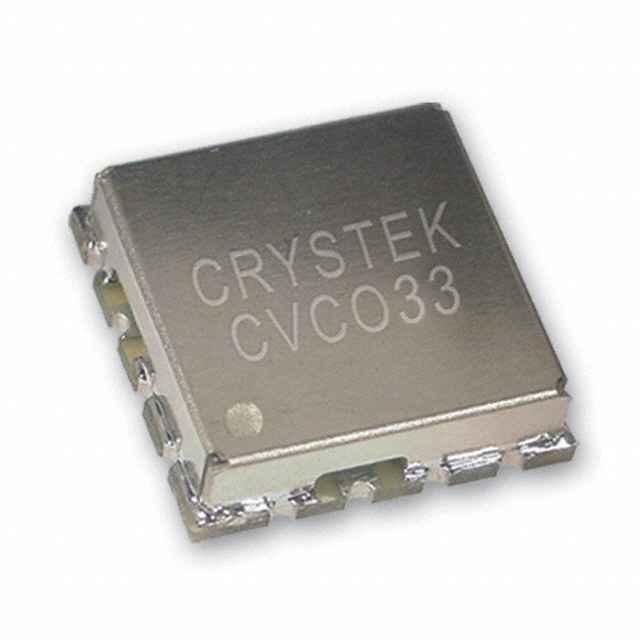
The CVCO33BE-2400-2500 is a voltage-controlled oscillator (VCO) manufactured by Crystek Corporation, designed for RF applications within the 2400 MHz to 2500 MHz frequency range. It features a center frequency of 2450 MHz and operates with a tuning voltage range of 0 V to 3 V. The device delivers an output power of +3 dBm and exhibits a phase noise performance of -100 dBc/Hz. This component utilizes a surface-mount package with dimensions of 7.62 mm x 7.62 mm, suitable for integration into wireless communication systems requiring stable high-frequency signal generation.
Verify the specific datasheet revision and pinout configuration against the target design schematic before procurement. Ensure that the supply voltage and tuning voltage ranges align with the system's power management architecture. Confirm that the thermal requirements of the surface-mount package are met within the final assembly environment to maintain frequency stability.
Select this component when a dedicated VCO solution is required for the 2.4 GHz band with precise voltage control. Consider the output power level and phase noise specifications relative to the system's sensitivity requirements. Evaluate the physical package size constraints against the available board space. Compare alternative models within the CVCO33 series if different frequency ranges or power levels are needed.
This part belongs to the CVCO33 series of voltage-controlled oscillators from Crystek Corporation. The series offers various frequency options tailored for wireless communication standards. The BE suffix typically denotes specific packaging or tuning characteristics within the product line. These components are engineered for reliability in consumer electronics and industrial RF applications.
Direct substitutes may include other Crystek CVCO33 series variants with matching frequency ranges, such as CVCO33BE-2400-2500_15. Cross-brand replacements require careful evaluation of pin compatibility, electrical parameters, and thermal performance to ensure functional equivalence without redesigning the host circuit.
 CVCO33BE-2400-2500
The activity of extra discounts on wholesale prices is in full swing…
Please fill in your contact information and we will send you the latest wholesale price list.