ChipApex | Global Electronic Components Supplier
SEARCH
Search Product
Search Post
— IC芯片 | 连接器 | 传感器 | 被动器件 —
Search productSearch post
— IC芯片 | 连接器 | 传感器 | 被动器件 —
Consult the customer manager about the wholesale price.
consultation hotline:86-132-6715-2157
email:[email protected]
Contact the product manager for consultation. One-stop consultation is available.
Do you want a lower wholesale price? Please send us your inquiry and we will reply immediately.
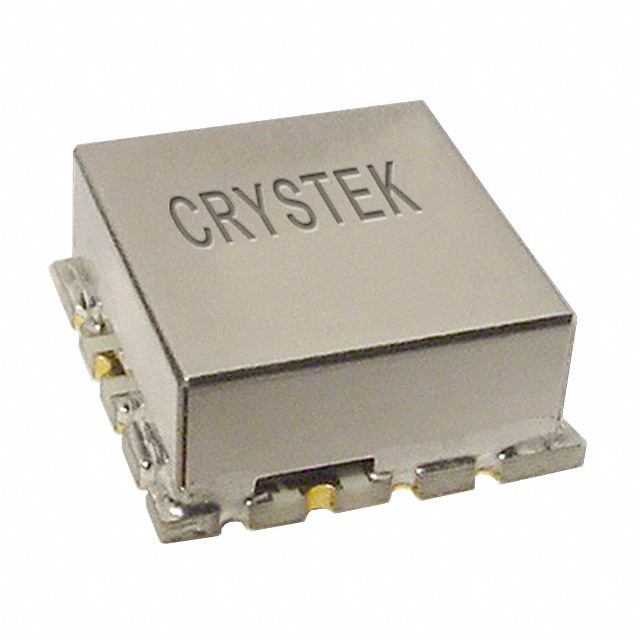
The CVCO55CC-2207-2207 is a Voltage Controlled Oscillator (VCO) manufactured by Crystek Corporation. It operates at a center frequency of 2.207 GHz with a load capacitance of 50 pF. The device functions within a temperature range of -40°C to +85°C and requires a 5V supply voltage. It utilizes a QFN-16 package with dimensions of 12.7x12.7 mm. The tuning voltage range is specified as 0.5V to 4.5V. This component is classified as a coaxial resonator oscillator designed for stable frequency generation in electronic circuits.
Verify the specific datasheet version from Crystek Corporation to confirm electrical characteristics and mechanical drawings. Ensure compatibility with the target PCB layout regarding the QFN-16 footprint and thermal requirements. Confirm that the operating environment stays within the specified -40°C to +85°C range. Check RoHS compliance status if required by project specifications. Validate that the 50 pF load capacitance matches the system design parameters.
Select this component when a fixed center frequency near 2.207 GHz is required with voltage-controlled tuning capabilities. Consider the QFN-16 package size constraints and the need for operation up to 85°C ambient temperature. Evaluate the 5V supply requirement against available power rails. Compare tuning sensitivity and phase noise specifications against other VCOs if detailed performance metrics are critical for the application.
This part belongs to the CVCO55CC series of Voltage Controlled Oscillators from Crystek Corporation. The series includes various models covering different frequency ranges, such as the CVCO55CC-1700-1700 and CVCO55CC-2032-2032. These components share similar packaging and operational principles but differ in center frequency and tuning ranges. The CVCO55CC-2207-2207 specifically targets applications requiring operation around the 2.2 GHz band.
No public confirmed substitute part numbers are identified in the provided documentation. Similar models in the CVCO55CC series may offer alternative frequencies but require verification of electrical compatibility.
 CVCO55CC-2207-2207
The activity of extra discounts on wholesale prices is in full swing…
Please fill in your contact information and we will send you the latest wholesale price list.