ChipApex | Global Electronic Components Supplier
SEARCH
Search Product
Search Post
— IC芯片 | 连接器 | 传感器 | 被动器件 —
Search productSearch post
— IC芯片 | 连接器 | 传感器 | 被动器件 —
Consult the customer manager about the wholesale price.
consultation hotline:86-132-6715-2157
email:[email protected]
Contact the product manager for consultation. One-stop consultation is available.
Do you want a lower wholesale price? Please send us your inquiry and we will reply immediately.
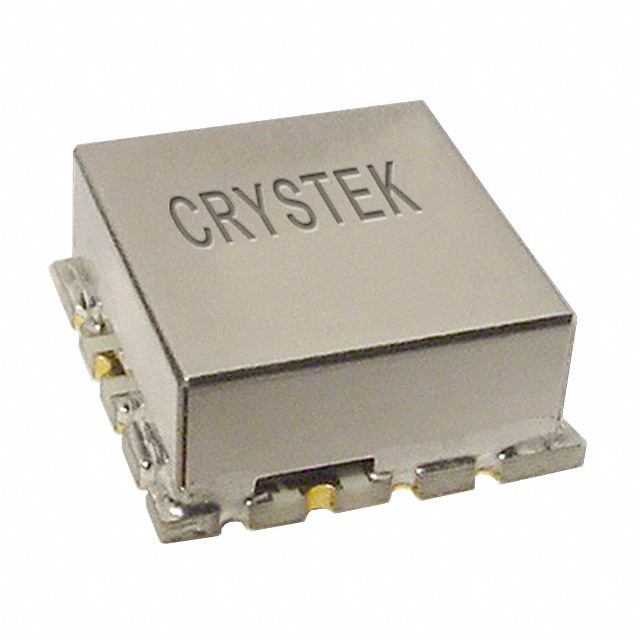
The CVCO55CC-3271-3503 is a Voltage Controlled Oscillator (VCO) from Crystek Corporation, designed for microwave applications. It operates within a frequency range of 3.271 GHz to 3.503 GHz, with a center frequency of 3387 MHz. The device features a tuning voltage range of 0.1 V to 16 V and delivers an output power of 5 ±2 dBm. It utilizes a 16-QFN package measuring 12.7 mm x 12.7 mm with a height of 5.59 mm. Key electrical specifications include a maximum supply current of 40 mA, a load capacitance of 10 pF, and a typical second harmonic suppression of -15 dBc.
Verify the specific suffix CC indicates the coaxial resonator variant when sourcing. Confirm the active product status and RoHS compliance details through official Crystek documentation before integration. Ensure the 16-QFN footprint matches the PCB layout requirements. Cross-reference the datasheet for precise tuning sensitivity and power consumption limits under varying thermal conditions.
Select this model for applications requiring a center frequency near 3.387 GHz with a narrow tuning range. The coaxial resonator construction offers distinct advantages over standard LC designs regarding phase noise and harmonic suppression. Consider the 0.1 V to 16 V control voltage compatibility with existing bias circuits. Evaluate the 40 mA current draw against system power budgets.
This component belongs to the CVCO55 series, which includes variants such as CVCO55BE for high frequencies and CVCO55CW for wide bands. The CC suffix specifically denotes the coaxial resonator architecture, differentiating it from other family members like the CL (narrow band) or CM (extra modulation port) versions. This series targets low phase noise and low harmonic requirements in the 38 MHz to 6900 MHz spectrum.
Public confirmed substitute part numbers are not available in the provided documentation. Direct replacement requires matching the 3.271–3.503 GHz range, 16-QFN package, and coaxial resonator type. Verify pinout compatibility and thermal characteristics if substituting with generic VCOs.
 CVCO55CC-3271-3503
The activity of extra discounts on wholesale prices is in full swing…
Please fill in your contact information and we will send you the latest wholesale price list.