 ChipApex | Global Electronic Components Supplier

SEARCH
Search Product
Search Post
— IC芯片 | 连接器 | 传感器 | 被动器件 —
Search productSearch post
— IC芯片 | 连接器 | 传感器 | 被动器件 —
Consult the customer manager about the wholesale price.
consultation hotline:86-132-6715-2157
email:[email protected]
Contact the product manager for consultation. One-stop consultation is available.
Do you want a lower wholesale price? Please send us your inquiry and we will reply immediately.
The CY74FCT825ATSOC is an 8-bit bus interface flip-flop manufactured by Texas Instruments, belonging to the FCT logic series. It features a single circuit with non-inverting polarity and single-ended inputs. The device provides three-state outputs and operates within a supply voltage range of 4.75 V to 5.25 V. It exhibits a propagation delay of 12.5 ns, with high-level output current capability of -32 mA and low-level output current of 64 mA. The component is housed in a 24-pin SOIC (DW) package, supports surface-mount installation, and functions across an operating temperature range from -40°C to +85°C.
Verify that the specific ordering suffix corresponds to the required package style and moisture sensitivity level. Confirm that the procurement channel sources components directly from authorized distributors or the manufacturer to ensure authenticity. Check for RoHS compliance documentation if environmental regulations apply to the final assembly. Ensure the supplier can provide traceability records consistent with Texas Instruments quality standards.
Select this component when an 8-bit latch with three-state output buffering is required for bus interfacing. Consider the 12.5 ns propagation delay and drive strength specifications against system timing requirements. Evaluate the SOIC-24 package dimensions for PCB layout constraints. Compare against other FCT series devices if different trigger types or pin counts are needed for the specific design topology.
This part belongs to the CY74FCT825T family of 8-bit bus interface flip-flops. It shares functional similarities with other octal registers but is distinct in its specific pinout and triggering mechanism. The FCT series bridges the gap between older TTL logic and modern CMOS performance, offering faster switching speeds while maintaining standard logic level compatibility.
The CY74FCT825ATSO is a verified substitute part number within the same product family, sharing identical electrical characteristics and pin configuration. Verify that any alternative sourcing matches the exact package width and thermal specifications to ensure mechanical compatibility.
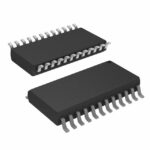 CY74FCT825ATSOC

The activity of extra discounts on wholesale prices is in full swing…
Please fill in your contact information and we will send you the latest wholesale price list.




