 ChipApex | Global Electronic Components Supplier
SEARCH
Search Product
Search Post
— IC芯片 | 连接器 | 传感器 | 被动器件 —
Search productSearch post
— IC芯片 | 连接器 | 传感器 | 被动器件 —
Consult the customer manager about the wholesale price.
consultation hotline:86-132-6715-2157
email:[email protected]
Contact the product manager for consultation. One-stop consultation is available.
Do you want a lower wholesale price? Please send us your inquiry and we will reply immediately.
The CY8CMBR2110 is a register-configurable CapSense Express controller supporting up to ten capacitive sensing buttons and ten general-purpose outputs (GPOs). It operates within a voltage range of 1.71 V to 5.5 V and features SmartSense Auto-Tuning for dynamic parameter adjustment. The device includes an I2C interface with speeds up to 100 kHz, Flanking Sensor Suppression (FSS), and system diagnostics. Power consumption in run mode is as low as 23 µA per button, with deep sleep current at 100 nA. It functions across an industrial temperature range of -40 °C to +85 °C and is housed in a 32-pin QFN package measuring 5 mm × 5 mm.
Verify the specific ordering suffix against official Infineon documentation to confirm package type and temperature grade. Ensure the EZ-Click Customizer tool version matches the device revision for accurate configuration generation. Confirm I2C address settings if multiple controllers are used on the same bus.
Select this component when firmware-free operation is required for up to ten buttons. It is suitable for designs needing direct GPO driving for LEDs or buzzers. Consider its wide voltage range for battery-powered applications. Evaluate the need for SmartSense auto-tuning to reduce development time compared to manually tuned solutions.
This part belongs to the Cypress CapSense Express family, now under Infineon Technologies. It is designed as a standalone controller that simplifies capacitive touch integration by eliminating the need for complex microcontroller programming. It complements other PSoC solutions by offering a dedicated, low-power touch sensing alternative.
Check for CY8CMBR2xxx series variants with different button counts. Verify pin compatibility if substituting with other CapSense Express controllers. Ensure the replacement supports the required I2C speed and operating voltage range.
It uses Flanking Sensor Suppression (FSS) to ensure only one button registers a touch state at a time, preventing false triggers from adjacent buttons.
Yes, it is register-configurable via the I2C interface using the EZ-Click Customizer tool, requiring no firmware coding on the host processor.
This line controls I2C communication, manages device power consumption modes, and signals the host processor regarding CapSense button status changes.
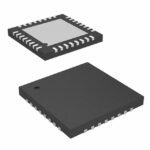 CY8CMBR2110-24LQXI
The activity of extra discounts on wholesale prices is in full swing…
Please fill in your contact information and we will send you the latest wholesale price list.





