 ChipApex | Global Electronic Components Supplier
SEARCH
Search Product
Search Post
— IC芯片 | 连接器 | 传感器 | 被动器件 —
Search productSearch post
— IC芯片 | 连接器 | 传感器 | 被动器件 —
Consult the customer manager about the wholesale price.
consultation hotline:86-132-6715-2157
email:[email protected]
Contact the product manager for consultation. One-stop consultation is available.
Do you want a lower wholesale price? Please send us your inquiry and we will reply immediately.
The DDA143TUQ-13-F is a PNP pre-biased dual transistor manufactured by Diodes Incorporated. It features an epitaxial planar die construction and integrates two biasing resistors within a single SOT363 package. The device is AEC-Q101 qualified for automotive applications and operates with a collector-emitter breakdown voltage of -50V and a continuous collector current of -100mA. Nominal input resistance (R1) is 4.7kΩ, with a DC current gain (hFE) ranging from 100 to 600 at IC = -1mA. Power dissipation is rated at 200mW, and the operating temperature range spans from -55°C to +150°C.
Verify component authenticity through authorized distribution channels to ensure compliance with automotive quality standards. Confirm that the ordering suffix corresponds to the required packaging quantity and reel specifications. Validate that the supplier provides traceability documentation consistent with IATF 16949 manufacturing processes. Ensure storage conditions adhere to moisture sensitivity level 1 guidelines prior to soldering.
Select this component when a dual PNP configuration with integrated biasing is required in a minimal footprint. The 4.7kΩ nominal input resistance suits standard logic interface voltages. Verify that the -50V collector-emitter breakdown voltage meets circuit requirements. Consider the 200mW power dissipation limit and thermal resistance characteristics during PCB layout planning.
This part belongs to the DDA series of pre-biased dual transistors offered by Diodes Incorporated. The 'U' designation indicates automotive-grade qualification under AEC-Q101 standards. The 'Q' suffix denotes the automotive variant, while '13-F' specifies the 10,000-unit tape and reel packaging format. It complements the DDC series which offers NPN configurations.
Direct functional substitutes include other DDA143TU variants such as DDA143TU-7-F, though packaging quantities differ. For automotive-specific replacements, verify AEC-Q101 qualification status. Non-automotive equivalents may lack the required change control documentation. Always validate pinout compatibility and electrical parameters before substitution.
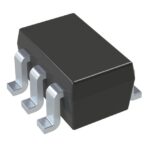 DDA143TUQ-13-F
The activity of extra discounts on wholesale prices is in full swing…
Please fill in your contact information and we will send you the latest wholesale price list.



