 ChipApex | Global Electronic Components Supplier
SEARCH
Search Product
Search Post
— IC芯片 | 连接器 | 传感器 | 被动器件 —
Search productSearch post
— IC芯片 | 连接器 | 传感器 | 被动器件 —
Consult the customer manager about the wholesale price.
consultation hotline:86-132-6715-2157
email:[email protected]
Contact the product manager for consultation. One-stop consultation is available.
Do you want a lower wholesale price? Please send us your inquiry and we will reply immediately.
The DDC123JU-7-F is a dual NPN pre-biased small signal surface mount transistor manufactured by Diodes Incorporated. It integrates two NPN transistors with built-in biasing resistors (R1 = 2.2 kΩ, R2 = 47 kΩ) in an SOT-363 package. The device features a collector-emitter breakdown voltage of 50 V and a continuous collector current of 100 mA. Power dissipation is rated at 200 mW, with an operating temperature range from -55°C to +150°C. The component is lead-free, RoHS compliant, and suitable for automated assembly.
Verify the specific ordering suffix against the manufacturer's official documentation to ensure correct packaging and status. Confirm that the requested part number matches the active status listed in the datasheet. Check for any recent product change notifications regarding manufacturing sites or materials before finalizing procurement orders.
Select this component when a dual NPN configuration with integrated biasing is required in a low-profile surface mount package. Ensure the input resistor values (2.2 kΩ and 47 kΩ) align with the target circuit's drive requirements. Verify that the 50 V voltage rating and 100 mA current capacity exceed the maximum operational stresses of the application.
This component belongs to the DDC(XXXX)U series of pre-biased transistors from Diodes Incorporated. The series offers various resistor combinations and configurations to replace multiple discrete components. The DDC123JU variant specifically provides dual NPN transistors with 2.2 kΩ and 47 kΩ resistors.
Direct replacement options include other DDC123 variants with different resistor values if electrical parameters allow. For automotive applications, verify AEC-Q101 qualification requirements. Consult the manufacturer's datasheet for recommended substitutions if the exact part number is unavailable.
The DDC123JU-7-F includes two resistors: R1 is 2.2 kΩ and R2 is 47 kΩ.
Yes, the DDC(XXXX)UQ versions are AEC-Q101 qualified and PPAP capable for automotive use, but standard versions should be verified for specific automotive requirements.
The maximum power dissipation is 200 mW, with a limit of 150 mW per element.
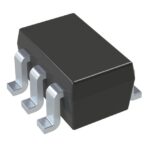 DDC123JU-7
The activity of extra discounts on wholesale prices is in full swing…
Please fill in your contact information and we will send you the latest wholesale price list.



