 ChipApex | Global Electronic Components Supplier
SEARCH
Search Product
Search Post
— IC芯片 | 连接器 | 传感器 | 被动器件 —
Search productSearch post
— IC芯片 | 连接器 | 传感器 | 被动器件 —
Consult the customer manager about the wholesale price.
consultation hotline:86-132-6715-2157
email:[email protected]
Contact the product manager for consultation. One-stop consultation is available.
Do you want a lower wholesale price? Please send us your inquiry and we will reply immediately.
The DRV8824QPWPRQ1 is an automotive-grade bipolar stepper motor driver integrating control logic and power MOSFETs in a 28-pin HTSSOP package. It operates on a supply voltage range of 8.2 V to 45 V with a maximum output current of 1.6 A per channel. The device supports step resolutions from full step to 1/32 microstepping via hardware inputs. It features adjustable current limiting, thermal shutdown, and under-voltage lockout for robust protection. The component is qualified to AEC-Q100 standards and functions within a junction temperature range of -40°C to +150°C.
Verify the complete part number including suffixes against official Texas Instruments documentation to ensure correct packaging and temperature grade. Confirm AEC-Q100 qualification status matches project requirements. Check for specific moisture sensitivity levels and recommended reflow profiles during assembly planning. Ensure compatibility with existing PCB footprint designs utilizing the 28-HTSSOP package dimensions.
Select this component when driving bipolar stepper motors requiring integrated control and power stages in automotive environments. Consider the 1.6 A output capability and 45 V supply limit for appropriate motor sizing. Evaluate the need for specific microstepping resolutions and external resistor settings for current regulation. Compare thermal performance requirements against the operating junction temperature limits provided in the datasheet.
This device belongs to the DRV8824 family of stepper motor drivers designed for automotive applications. It serves as a fully integrated solution replacing discrete driver circuits. The Q1 suffix indicates automotive qualification. The PWPRQ1 suffix denotes the 28-HTSSOP package and tape-and-reel shipping format. It complements other TI motor control products by offering simplified design implementation for precision motion control tasks.
Consult official substitution lists for equivalent automotive-qualified stepper drivers. Verify pin-to-pin compatibility if replacing legacy components. Ensure electrical parameters such as supply voltage range and current capacity meet system specifications before swapping parts.
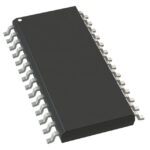 DRV8824QPWPRQ1
The activity of extra discounts on wholesale prices is in full swing…
Please fill in your contact information and we will send you the latest wholesale price list.





