 ChipApex | Global Electronic Components Supplier
SEARCH
Search Product
Search Post
— IC芯片 | 连接器 | 传感器 | 被动器件 —
Search productSearch post
— IC芯片 | 连接器 | 传感器 | 被动器件 —
Consult the customer manager about the wholesale price.
consultation hotline:86-132-6715-2157
email:[email protected]
Contact the product manager for consultation. One-stop consultation is available.
Do you want a lower wholesale price? Please send us your inquiry and we will reply immediately.
The DRV8848PWP is a dual H-bridge motor driver manufactured by Texas Instruments, designed for driving brushed DC motors and stepper motors. It operates within a supply voltage range of 2.7 V to 18 V and supports continuous output currents up to 1.5 A per bridge with peak currents reaching 3 A. The device integrates power MOSFETs in an HTSSOP-16 package (PWPR variant available). Key features include overcurrent protection, thermal shutdown, and low standby current. It is suitable for applications requiring compact motor control solutions.
Verify the exact part number suffix to confirm packaging type; PWP indicates tube packaging while PWPR indicates reel packaging. Confirm RoHS compliance status and lead times directly with authorized distributors. Ensure proper ESD handling procedures are followed during storage and assembly due to the sensitivity of the integrated circuit components.
Select this component when a dual H-bridge configuration is required for driving two brushed DC motors or one bipolar stepper motor. Consider the 1.5 A continuous current rating and 18 V maximum supply voltage limits. Evaluate thermal management requirements based on expected load conditions and ambient temperature. Compare against single H-bridge alternatives if only one motor channel is needed to optimize board space and cost.
The DRV8848 belongs to Texas Instruments' DRV88xx series of motor drivers, which are designed for various motor control applications. This specific model focuses on dual H-bridge functionality within a compact footprint. It complements other variants like the DRV8847 and DRV8849, offering different current ratings and feature sets to suit diverse design requirements in consumer and industrial electronics.
Direct pin-to-pin replacements may include the DRV8847PWP or DRV8849PWP depending on current requirements. Verify compatibility with existing PCB layout and firmware controls. Ensure that alternative parts meet the same voltage and current specifications for seamless integration without redesigning the power stage.
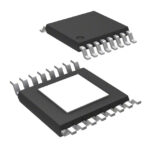 DRV8848PWP
The activity of extra discounts on wholesale prices is in full swing…
Please fill in your contact information and we will send you the latest wholesale price list.





