 ChipApex | Global Electronic Components Supplier
SEARCH
Search Product
Search Post
— IC芯片 | 连接器 | 传感器 | 被动器件 —
Search productSearch post
— IC芯片 | 连接器 | 传感器 | 被动器件 —
Consult the customer manager about the wholesale price.
consultation hotline:86-132-6715-2157
email:[email protected]
Contact the product manager for consultation. One-stop consultation is available.
Do you want a lower wholesale price? Please send us your inquiry and we will reply immediately.
The DS1023S-50+ is an 8-bit programmable timing element manufactured by Analog Devices Inc./Maxim Integrated. It operates on a single 5V supply (4.75V to 5.25V) and features a delay step size of 0.5 ns with a maximum delay time of 127.5 ns. The device supports both parallel and serial programming modes, allowing flexible configuration for various timing applications. It is housed in a 16-pin SOIC package and functions within an operating temperature range of 0°C to +70°C.
Verify the component against official datasheets to confirm pinout compatibility and electrical specifications. Ensure that the operating voltage and temperature ranges align with your system requirements. Check for any specific handling instructions related to the SOIC package and CMOS technology.
Consider the required delay resolution and maximum delay time when selecting this component. Evaluate whether parallel or serial programming best suits your application's control interface. Assess the impact of the on-chip reference delay on overall system accuracy and ensure it meets your design needs.
The DS1023 series includes variants with different step sizes (0.25 ns, 0.5 ns, 1 ns, 2 ns, 5 ns). The DS1023S-50+ specifically offers a 0.5 ns step size, making it suitable for applications requiring moderate delay precision. Other series members may have different maximum delays and input frequency limits.
Direct replacements include other DS1023 variants with compatible step sizes and packaging. Verify functional equivalence regarding programming modes and output configurations before substitution.
The on-chip reference delay compensates for the inherent 'step zero' delay caused by propagation through input and output buffers, allowing for accurate relative timing measurements.
Yes, by connecting the inverted output (OUT) externally to the input (IN), the device can function as a free-running oscillator with a frequency determined by the programmed delay value.
The delay value can be programmed using either parallel inputs (P0-P7) or serial data (D/CLK), controlled by the P/S pin to select the desired mode.


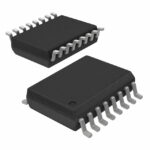 DS1023S-50+
The activity of extra discounts on wholesale prices is in full swing…
Please fill in your contact information and we will send you the latest wholesale price list.




