 ChipApex | Global Electronic Components Supplier
SEARCH
Search Product
Search Post
— IC芯片 | 连接器 | 传感器 | 被动器件 —
Search productSearch post
— IC芯片 | 连接器 | 传感器 | 被动器件 —
Consult the customer manager about the wholesale price.
consultation hotline:86-132-6715-2157
email:[email protected]
Contact the product manager for consultation. One-stop consultation is available.
Do you want a lower wholesale price? Please send us your inquiry and we will reply immediately.
The DS1023S-50 is an 8-bit programmable timing element manufactured by Analog Devices Inc./Maxim Integrated. It operates on a single 5V supply (4.75V to 5.25V) and features a delay step size of 0.5 ns with a maximum delay time of 127.5 ns. The device supports both parallel and serial programming modes, allowing flexible configuration for various timing applications. It is housed in a 16-pin SOIC package and functions within an operating temperature range of 0°C to 70°C.
Verify the specific suffix 'S' indicates the SOIC package variant when sourcing. Confirm the manufacturer designation as Analog Devices Inc./Maxim Integrated. Ensure the component meets the required operating temperature range of 0°C to 70°C for your application environment.
Select this model for applications requiring precise 0.5 ns resolution timing adjustments up to 127.5 ns. Consider the serial interface if space is limited, or parallel mode for direct bus connection. Ensure the input signal rise/fall times are within specified limits for accurate delay performance.
This component belongs to the DS1023 family of 8-bit programmable timing elements. It shares functional similarities with the DS1020/DS1021 but offers enhanced features like configurable output modes and extended delay capabilities relative to clock periods.
Direct substitutes include other models from the DS1023 series such as DS1023S-25, DS1023S-100, DS1023S-200, and DS1023S-500, which offer different step sizes and maximum delay ranges while maintaining the same package and pinout.
When MS=0, it serves as the Reference Output providing a fixed delay copy of the input. When MS=1, it acts as the Pulse Width Modulated Output triggered by the input waveform.
Unused parallel input pins (P3-P7) must be connected to well-defined logic levels and not allowed to float. The serial output Q/P0 can be left floating if unused.
Yes, by connecting the inverted OUT pin externally to the IN pin, the device can function as a free-running oscillator with frequency determined by the programmed delay value.
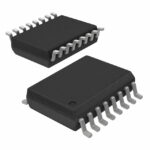 DS1023S-50
The activity of extra discounts on wholesale prices is in full swing…
Please fill in your contact information and we will send you the latest wholesale price list.





