 ChipApex | Global Electronic Components Supplier
SEARCH
Search Product
Search Post
— IC芯片 | 连接器 | 传感器 | 被动器件 —
Search productSearch post
— IC芯片 | 连接器 | 传感器 | 被动器件 —
Consult the customer manager about the wholesale price.
consultation hotline:86-132-6715-2157
email:[email protected]
Contact the product manager for consultation. One-stop consultation is available.
Do you want a lower wholesale price? Please send us your inquiry and we will reply immediately.
The DS1073M-100 is a fixed-frequency oscillator and divider from Analog Devices Inc./Maxim Integrated, designed for 3V applications. It features dual outputs (I/O and OUT0) with a maximum frequency of 100MHz. The device incorporates user-programmable on-chip dividers (1 to 513) and prescalers (1, 2, 4), stored in non-volatile memory. It supports internal, external clock, or crystal references. Operating voltage ranges from 2.7V to 3.6V. Key specifications include ±0.5% initial tolerance, ±1% variation over commercial temperature/voltage, and synchronous output gating. Supply current is typically 40mA at 15pF load.
Verify the specific suffix 'M' indicates the 300-mil DIP package variant. Confirm programming requirements; devices are shipped configured for half the maximum operating frequency unless factory-programmed otherwise. Ensure supply voltage remains within 2.7V to 3.6V for specified performance. Check temperature range compliance (commercial vs industrial) against application needs.
Select the DS1073M-100 when a fixed 100MHz output is required without external crystals or resonators. Consider the MUX and DIV register configurations for frequency scaling if lower frequencies are needed. Evaluate the PDN/SELX pin functionality based on whether power-down or source selection switching is required. Compare supply current and jitter specifications against system timing constraints.
The DS1073 series includes variants like DS1073M/Z-80 (80MHz), DS1073M/Z-66 (66.667MHz), and DS1073M/Z-60 (60MHz). The 'M' suffix denotes the 300-mil DIP package, while 'Z' denotes the 150-mil SOIC package. All variants share the same functional architecture and programming interface.
Public confirmed substitute part numbers are not available in the provided documentation. Users should verify pin compatibility and electrical specifications if considering alternative oscillators.
Programming is performed via a 1-Wire protocol using the I/O pin. A pullup resistor must be connected to VCC before power-up to enter programming mode.
OUT0 provides a buffered output of the master reference clock (internal or external). It is unaffected by the OE pin but is disabled during power-down if EN0 bit is set.
Yes, if the PDN bit is programmed to 0, the PDN/SELX pin can be used to switch between the internal oscillator and an external reference/crystal on the fly.


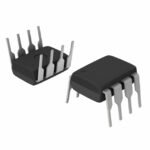 DS1073M-100
The activity of extra discounts on wholesale prices is in full swing…
Please fill in your contact information and we will send you the latest wholesale price list.



