 ChipApex | Global Electronic Components Supplier
SEARCH
Search Product
Search Post
— IC芯片 | 连接器 | 传感器 | 被动器件 —
Search productSearch post
— IC芯片 | 连接器 | 传感器 | 被动器件 —
Consult the customer manager about the wholesale price.
consultation hotline:86-132-6715-2157
email:[email protected]
Contact the product manager for consultation. One-stop consultation is available.
Do you want a lower wholesale price? Please send us your inquiry and we will reply immediately.
The DS1077U-100+T&R is a dual-output, programmable fixed-frequency oscillator from the EconOscillator family. It operates on a single 5V supply (4.75V to 5.25V) and requires no external components. The device features two synchronous outputs with frequencies ranging from 8.1kHz to 133MHz. It includes a 2-wire serial interface for on-the-fly programming of prescalers and dividers, with settings stored in nonvolatile EEPROM memory. Key electrical parameters include an active supply current of 50mA typical, standby current of 5µA, and output jitter of 30ps pk-to-pk at 133MHz.
Verify the 'U' suffix indicates the 8-pin 118mil µSOP package. Confirm the '+T&R' suffix corresponds to tape and reel packaging if required for assembly. Check for RoHS compliance status as indicated by the '+' suffix in official documentation.
Select this model for applications requiring a 100MHz master frequency option within the 8.1kHz to 133MHz range. Ensure the system voltage is strictly maintained between 4.75V and 5.25V. Consider the 118mil µSOP package dimensions for PCB layout constraints compared to the standard SO package.
This component belongs to the DS1077 EconOscillator/Divider series manufactured by Analog Devices / Maxim Integrated. The 'U' designation specifically identifies the µSOP package variant, distinguishing it from the standard SO package ('Z') or other voltage variants like the 3V versions.
Direct replacements must match the 5V supply requirement and 8-pin µSOP footprint. Other models in the DS1077 series (e.g., DS1077Z-100) offer identical functionality but differ in package type. Verify pin compatibility before substitution.
CTRL0 and CTRL1 are multifunctional input pins that can be configured via control registers to serve as Output Enable or Power-Down controls for the respective outputs.
Frequencies are determined by internal factory-trimmed master oscillators divided by programmable prescalers (P0, P1) and a programmable divider (N), which are set via the 2-wire serial interface.
Upon power-up, the device defaults to the frequency values previously stored in its nonvolatile EEPROM memory.

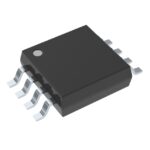 DS1077U-100+T&R
The activity of extra discounts on wholesale prices is in full swing…
Please fill in your contact information and we will send you the latest wholesale price list.




