 ChipApex | Global Electronic Components Supplier
SEARCH
Search Product
Search Post
— IC芯片 | 连接器 | 传感器 | 被动器件 —
Search productSearch post
— IC芯片 | 连接器 | 传感器 | 被动器件 —
Consult the customer manager about the wholesale price.
consultation hotline:86-132-6715-2157
email:[email protected]
Contact the product manager for consultation. One-stop consultation is available.
Do you want a lower wholesale price? Please send us your inquiry and we will reply immediately.
The DS1081LE+T is a spread-spectrum clock modulator IC designed to reduce electromagnetic interference (EMI) in digital electronic equipment. It accepts an input clock signal between 20MHz and 134MHz and delivers a center-dithered output using an integrated phase-locked loop (PLL). The device operates on a single 3.3V supply, consumes 15mA at maximum frequency, and features low cycle-to-cycle jitter of 75ps. Packaged in an 8-pin TSSOP, it supports selectable dither magnitudes from ±0.5% to ±2.0% and functions within an automotive temperature range of -40°C to +125°C.
Verify that the ordering suffix 'T' corresponds to tape-and-reel packaging as specified in the manufacturer's documentation. Confirm the component meets lead-free and RoHS compliance requirements indicated by the '+' designation. Ensure the specific batch matches the -40°C to +125°C automotive temperature grade.
Select this component when EMI reduction is required without altering clock rise/fall times or adding mechanical shielding. Ensure the system clock frequency falls within the 20MHz to 134MHz operational range. Verify that the power supply voltage remains between 3.0V and 3.6V and that the application environment accommodates the extended -40°C to +125°C temperature specification.
The DS1081L series serves as a direct replacement for the Alliance/PulseCore Semiconductor P2040 series devices, offering pin compatibility. The 'E' suffix denotes the extended automotive temperature range (-40°C to +125°C), while the 'T' suffix indicates tape-and-reel packaging for automated assembly processes.
The DS1081LE+T is pin-compatible with the Alliance/PulseCore Semiconductor P2040 series. Substitution should verify that the target device supports the same 20MHz to 134MHz input frequency range and 3.3V supply voltage constraints.
The dither magnitude is selected via the SMSEL1 and SMSEL2 input pins, allowing configurations for ±0.5%, ±1.0%, ±1.5%, or ±2.0%.
The SSEN pin enables or disables spread-spectrum modulation and can three-state the SSO output when left open.
The dither rate is determined by the input frequency (fIN) and configured via the CRSEL pin to ensure the rate remains above the audio frequency range.
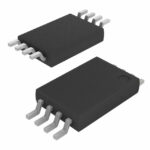 DS1081LE+T
The activity of extra discounts on wholesale prices is in full swing…
Please fill in your contact information and we will send you the latest wholesale price list.





