 ChipApex | Global Electronic Components Supplier
SEARCH
Search Product
Search Post
— IC芯片 | 连接器 | 传感器 | 被动器件 —
Search productSearch post
— IC芯片 | 连接器 | 传感器 | 被动器件 —
Consult the customer manager about the wholesale price.
consultation hotline:86-132-6715-2157
email:[email protected]
Contact the product manager for consultation. One-stop consultation is available.
Do you want a lower wholesale price? Please send us your inquiry and we will reply immediately.
The DS1086LU-527+T is a 3.3V programmable clock generator featuring spread-spectrum capabilities. It generates square-wave outputs from 130kHz to 66.6MHz with selectable dithering of 0.5%, 1%, 2%, 4%, or 8% below the programmed frequency to reduce radiated emissions. The device operates on a 2.7V to 3.6V supply and includes a power-down mode and glitchless output-enable control. All settings are stored in nonvolatile EEPROM, allowing standalone operation without external timing components.
Verify the specific ordering suffix against the manufacturer's current documentation to confirm package type and lead-free status. The datasheet indicates that the '+' suffix denotes a lead-free/RoHS-compliant package in an 8-pin μSOP. Confirm availability through authorized distributors as supply may be restricted.
Select this component when a low-component-count, programmable clock source with spread-spectrum features is required. Ensure the application voltage falls within the 2.7V to 3.6V range. Verify that the required output frequency can be achieved using the internal master oscillator and prescaler settings defined in the datasheet tables.
The DS1086L series belongs to Maxim Integrated's EconOscillator family, designed to replace traditional crystal oscillators and multipliers. The 'LU' designation specifies the industrial temperature range (-40°C to +85°C) and the 8-pin μSOP package. This part integrates the oscillator, divider, and EEPROM into a single compact solution.
Direct replacements must match the 3.3V supply, 8-pin μSOP package, and 2-wire interface. Check if alternative models in the DS1086L family offer different default frequencies or dither ranges suitable for the specific design requirements.
The output frequency is calculated based on the OFFSET, DAC, and prescaler registers. The formula is: f_OUTPUT = (MIN FREQUENCY OF SELECTED OFFSET RANGE + (DAC VALUE x 5kHz)) / Prescaler.
The SPRD pin enables or disables the spread-spectrum dithering. When high, dither is enabled; when low, it is disabled.
Yes, because all settings are stored in nonvolatile EEPROM, the device can operate in a standalone mode after initial programming.
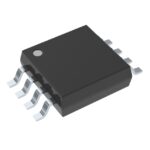 DS1086LU-527+T
The activity of extra discounts on wholesale prices is in full swing…
Please fill in your contact information and we will send you the latest wholesale price list.





