 ChipApex | Global Electronic Components Supplier
SEARCH
Search Product
Search Post
— IC芯片 | 连接器 | 传感器 | 被动器件 —
Search productSearch post
— IC芯片 | 连接器 | 传感器 | 被动器件 —
Consult the customer manager about the wholesale price.
consultation hotline:86-132-6715-2157
email:[email protected]
Contact the product manager for consultation. One-stop consultation is available.
Do you want a lower wholesale price? Please send us your inquiry and we will reply immediately.
The DS1302S+ is a low-power real-time clock (RTC) and calendar integrated circuit manufactured by Analog Devices Inc./Maxim Integrated. It provides seconds, minutes, hours, date, month, day of the week, and year information with leap-year compensation valid through 2100. The device features 31 bytes of battery-backed static RAM and communicates via a simple 3-wire serial interface compatible with most microcontrollers. Operating on a supply voltage of 2V to 5.5V, it consumes less than 300nA at 2.0V. The component is housed in an 8-pin SOIC package (208 mils width) and supports commercial temperature operation from 0°C to +70°C.
Verify that the specific order corresponds to the 'S' suffix variant, which denotes the 8-pin SOIC (208 mils) package. Confirm the operating temperature range requirement matches the commercial grade (0°C to +70°C), as industrial variants (-40°C to +85°C) utilize different suffixes such as 'SN'. Ensure compatibility with the required PCB footprint for the 8-SOIC package.
Select this component when a 3-wire serial interface is preferred over I2C or SPI protocols. The DS1302S+ is suitable for applications requiring a wide supply voltage range (2V–5.5V) and low standby current. Note that the internal oscillator requires an external 32.768kHz crystal with a specified load capacitance of 6pF. For designs requiring extended temperature ranges, consider the DS1302SN+ instead.
The DS1302 series serves as a successor to the DS1202, offering enhanced features such as dual power pins for primary and backup supplies and a programmable trickle charger. The 'S' suffix specifically identifies the standard-width 8-pin SOIC package (208 mils). Other variants include the narrow SOIC ('Z') and DIP packages ('P'), available in both commercial and industrial temperature grades.
For industrial temperature range requirements (-40°C to +85°C) in the same package, use DS1302SN+. For narrow SOIC packages, consider DS1302Z+ (commercial) or DS1302ZN+ (industrial). Direct pin-compatible replacements with different interfaces, such as the DS1307 (I2C), require software and schematic modifications.
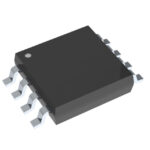 DS1302S+
The activity of extra discounts on wholesale prices is in full swing…
Please fill in your contact information and we will send you the latest wholesale price list.




