 ChipApex | Global Electronic Components Supplier
SEARCH
Search Product
Search Post
— IC芯片 | 连接器 | 传感器 | 被动器件 —
Search productSearch post
— IC芯片 | 连接器 | 传感器 | 被动器件 —
Consult the customer manager about the wholesale price.
consultation hotline:86-132-6715-2157
email:[email protected]
Contact the product manager for consultation. One-stop consultation is available.
Do you want a lower wholesale price? Please send us your inquiry and we will reply immediately.
The DS90CR483VJDX is a discontinued LVDS interface serializer manufactured by Texas Instruments. It converts 48 parallel CMOS or TTL inputs into eight serial LVDS differential outputs. The device supports data rates up to 672 Mb/s per channel, achieving a total throughput of 5.38 Gbps. It operates on a single 3.3 V power supply with a range of 3.0 V to 3.6 V. The component is housed in a 100-pin TQFP package and functions within an operating temperature range of -10°C to +70°C. It features low power dissipation of 2.3 W and includes ESD protection.
This specific part number is marked as Not Recommended for New Designs (NRND) and has been discontinued. Verification of current availability requires checking authorized distributors for remaining stock or obsolete inventory. Sourcing should prioritize the direct replacement part number DS90CR483VJDX/NOPB to ensure RoHS compliance and ongoing manufacturing support. Confirm lead times carefully due to potential supply chain constraints for end-of-life components.
Select this component only for legacy system maintenance or repair where pin compatibility is critical. For new designs, evaluate the DS90CR483VJDX/NOPB variant which offers identical functionality with updated environmental compliance. Ensure the design accommodates the 100-TQFP package dimensions and thermal requirements. Verify that the host system provides the necessary 3.3 V power rail and that trace impedance matches the LVDS differential pair specifications.
The DS90CR483 belongs to the DS90CR48x series of LVDS serializers designed for high-bandwidth video applications. It serves as the transmitter counterpart to receivers like the DS90CF388. This series enables the transmission of large pixel data arrays over twisted-pair cables with reduced electromagnetic interference compared to parallel interfaces.
The direct replacement is DS90CR483VJDX/NOPB. This variant maintains functional equivalence while adhering to RoHS standards. No other cross-model substitutes are confirmed in public documentation.
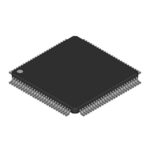 DS90CR483VJDX
The activity of extra discounts on wholesale prices is in full swing…
Please fill in your contact information and we will send you the latest wholesale price list.





