 ChipApex | Global Electronic Components Supplier
SEARCH
Search Product
Search Post
— IC芯片 | 连接器 | 传感器 | 被动器件 —
Search productSearch post
— IC芯片 | 连接器 | 传感器 | 被动器件 —
Consult the customer manager about the wholesale price.
consultation hotline:86-132-6715-2157
email:[email protected]
Contact the product manager for consultation. One-stop consultation is available.
Do you want a lower wholesale price? Please send us your inquiry and we will reply immediately.
The DS92LV1224TMSA/NOPB is a 30-66 MHz, 10-bit Bus LVDS deserializer manufactured by Texas Instruments. It converts a serial data stream into a 10-bit parallel bus with a throughput of 300 to 660 Mb/s. The device operates on a single 3.3 V supply (3.0 V to 3.6 V) and consumes less than 300 mW at 66 MHz. It features an internal PLL for clock recovery from embedded clock bits within the serial data stream. The component is housed in a 28-lead SSOP package and supports operation across a temperature range of -40°C to +85°C.
Verify the specific ordering suffix against the manufacturer's current documentation to confirm package type and environmental rating. Confirm availability status as production data may indicate end-of-life phases. Ensure the design includes proper termination resistors for the Bus LVDS inputs to maintain signal integrity and prevent noise pickup when the receiver is not actively driven.
Select this component when a 10-bit parallel interface must be converted to a single differential serial link operating between 30 MHz and 66 MHz. It requires a compatible 10-bit serializer, such as the DS92LV1023E, to form a complete chipset. Ensure the application provides a stable reference clock (REFCLK) to the deserializer for accurate PLL locking and data recovery.
This device belongs to the DS92LV1224 series of Bus LVDS serializers and deserializers. It is designed to work in conjunction with specific Texas Instruments serializers to reduce PCB trace count and minimize electromagnetic interference compared to parallel interfaces. The technology simplifies routing by narrowing data paths into a single differential pair.
Public confirmed substitute part numbers are not available in the provided documentation. Verify compatibility with existing serializer components before considering alternative devices.
If the deserializer loses lock, the LOCK output goes high and the outputs enter TRI-STATE. The system can detect this state and pulse the serializer's SYNC pins to resend synchronization patterns, allowing the deserializer to resynchronize.
The RMT (Repetitive Multi-Transition) detection circuitry prevents 'false lock' scenarios where the deserializer might incorrectly lock to a repetitive data pattern instead of the embedded clock bits. It ensures the LOCK output remains inactive until valid clock transitions are detected.
Yes, the device supports hot insertion into a running backplane. It utilizes random lock circuitry to acquire the clock and data from the incoming stream without requiring initial synchronization patterns, provided the ground pin makes contact first.
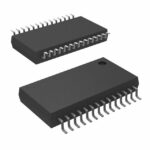 DS92LV1224TMSA/NOPB
The activity of extra discounts on wholesale prices is in full swing…
Please fill in your contact information and we will send you the latest wholesale price list.





