 ChipApex | Global Electronic Components Supplier
SEARCH
Search Product
Search Post
— IC芯片 | 连接器 | 传感器 | 被动器件 —
Search productSearch post
— IC芯片 | 连接器 | 传感器 | 被动器件 —
Consult the customer manager about the wholesale price.
consultation hotline:86-132-6715-2157
email:[email protected]
Contact the product manager for consultation. One-stop consultation is available.
Do you want a lower wholesale price? Please send us your inquiry and we will reply immediately.
The DZ23C36_R1_00001 is a dual surface mount Zener diode from the DZ23C2V4 series manufactured by Panjit International Inc. It features a common cathode configuration within an SOT-23 molded plastic package. The nominal Zener voltage is 36 V, with a maximum Zener impedance of 90 Ohms at a test current of 5 mA and a maximum reverse leakage current of 100 µA at 27 V. The device supports a power dissipation rating of 300 mW and operates within a junction temperature range of -65°C to +150°C. It is supplied in tape and reel packaging on a 13-inch plastic reel.
Verify the specific ordering suffix against manufacturer documentation to confirm packing type and reel size. The R1 suffix indicates Tape and Reel packaging on a 7-inch reel. Confirm compliance requirements such as RoHS 2.0 and IEC 61249 green molding standards prior to integration. Ensure the component lot number is recorded for traceability purposes during quality assurance processes.
Select this component when a dual Zener solution with a common cathode topology is required in an SOT-23 footprint. The 300 mW power rating suits low-current regulation tasks. Verify that the 90 Ohm impedance and 100 µA leakage specifications align with the target circuit's noise and precision constraints. Consider the -65°C to +150°C operating range for environmental suitability.
This part belongs to the DZ23C2V4 series, which covers nominal Zener voltages ranging from 2.4 V to 51 V. All members of this series share the same physical SOT-23 package dimensions and mechanical data. The series is designed for automatic insertion processes, making it suitable for high-volume manufacturing environments requiring consistent surface-mount assembly.
Direct replacements must match the SOT-23-3 package, 36 V nominal voltage, and common cathode configuration. Verify that substitute components meet or exceed the 300 mW power dissipation and -65°C to +150°C temperature range specifications. Cross-reference datasheets for equivalent Zener impedance and leakage current limits to ensure circuit performance parity.
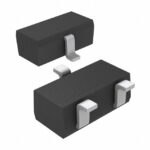 DZ23C36_R1_00001
The activity of extra discounts on wholesale prices is in full swing…
Please fill in your contact information and we will send you the latest wholesale price list.




