 ChipApex | Global Electronic Components Supplier
SEARCH
Search Product
Search Post
— IC芯片 | 连接器 | 传感器 | 被动器件 —
Search productSearch post
— IC芯片 | 连接器 | 传感器 | 被动器件 —
Consult the customer manager about the wholesale price.
consultation hotline:86-132-6715-2157
email:[email protected]
Contact the product manager for consultation. One-stop consultation is available.
Do you want a lower wholesale price? Please send us your inquiry and we will reply immediately.
The DZ23C7V5-HE3_A-08 is a silicon planar Zener diode from the Vishay DZ23 series, housed in an SOT-23 surface-mount package. It features a nominal Zener voltage of 7.5 V with a standard tolerance of ±5 %. The device operates at a test current of 5 mA and exhibits a maximum reverse leakage current of 1 μA at 5 V. Dynamic resistance is specified at 7 Ω, while the temperature coefficient ranges between 3 and 7 x 10⁻⁴/°C. Qualified under AEC-Q101 standards, it supports an operating temperature range from -55 °C to +150 °C.
Verify component authenticity by cross-referencing the manufacturer's document number 86346 and revision 1.2 against official Vishay channels. Confirm that the ordering suffix HE3_A-08 corresponds to the specific AEC-Q101 qualified variant packaged in taped units per reel. Ensure compliance with RoHS directives as indicated by the base part nomenclature before finalizing acquisition.
Select this component when a dual Zener array in a small outline package is required for space-constrained designs. The common cathode arrangement allows independent control of two voltage references or clamping paths. Verify that the 7.5 V nominal rating aligns with circuit requirements and that the 5 mA test current matches the intended biasing conditions for optimal regulation performance.
This device belongs to the DZ23 series of small signal Zener diodes manufactured by Vishay Semiconductors. The series encompasses a wide range of voltages from 2.2 V to 75 V, all graded according to the international E24 standard. These components are designed for general-purpose voltage regulation and protection tasks in commercial and automotive electronics.
Direct substitutes within the same family include other DZ23 variants such as DZ23C7V5-E3-18, though these may lack AEC-Q101 qualification. Cross-manufacturer equivalents must be evaluated for pin compatibility, power dissipation limits, and electrical parameter tolerances to ensure functional interchangeability.
The device provides ESD protection greater than 8 kV according to the human body model and greater than 800 V according to the machine model, as defined by AEC-Q101.
The junction-to-lead thermal resistance is 250 K/W, allowing up to 500 mW dissipation when leads are clamped. On an FR-4 board, the junction-to-ambient thermal resistance is 420 K/W, limiting dissipation to 300 mW.
The component contains two Zener diodes arranged in a common cathode configuration within a single SOT-23 package.
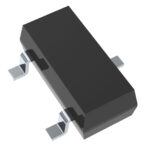 DZ23C7V5-HE3_A-08
The activity of extra discounts on wholesale prices is in full swing…
Please fill in your contact information and we will send you the latest wholesale price list.




