 ChipApex | Global Electronic Components Supplier
SEARCH
Search Product
Search Post
— IC芯片 | 连接器 | 传感器 | 被动器件 —
Search productSearch post
— IC芯片 | 连接器 | 传感器 | 被动器件 —
Consult the customer manager about the wholesale price.
consultation hotline:86-132-6715-2157
email:[email protected]
Contact the product manager for consultation. One-stop consultation is available.
Do you want a lower wholesale price? Please send us your inquiry and we will reply immediately.
The DZ23C9V1-HE3-18 is a silicon planar Zener diode array from the Vishay DZ23 series, housed in an SOT-23 surface-mount package. It features a common cathode configuration with two independent diodes sharing a single ground terminal. The nominal Zener voltage is 9.1 V with a tolerance of ±5%. Electrical characteristics include a maximum reverse leakage current of 0.1 µA at 7 V and a dynamic resistance of 10 Ω at a test current of 5 mA. The device supports a maximum power dissipation of 300 mW on an FR-4 board and operates within a temperature range of -55 °C to +150 °C.
Verify component authenticity through authorized distribution channels or direct manufacturer engagement. Confirm that the specific HE3_A suffix aligns with required automotive grade specifications and RoHS compliance standards. Ensure storage conditions adhere to moisture sensitivity level 1 guidelines to prevent package degradation prior to soldering.
Evaluate the thermal resistance parameters against the expected ambient operating temperatures to ensure junction limits are not exceeded. Compare the dynamic impedance values with the target application's noise requirements. Verify that the SOT-23 footprint dimensions match the printed circuit board design constraints and soldering profile capabilities.
This component belongs to the DZ23 series of small signal Zener diodes manufactured by Vishay General Semiconductor. The series offers a wide range of standardized voltage options graded according to the E24 standard. The DZ23C9V1 variant specifically targets applications requiring a precise 9.1 V regulation point within a minimal surface-mount form factor.
Direct functional equivalents include the DZ23C9V1-E3-18 and DZ23C9V1-G3-18. These alternatives share identical electrical characteristics and physical packaging but may differ in commercial versus automotive qualification status. Cross-referencing datasheets is necessary to confirm pinout compatibility and thermal performance metrics.
The maximum power dissipation is 500 mW when mounted directly to leads, and 300 mW when mounted on an FR-4 board using the recommended soldering footprint.
No, the suffix indicates manufacturing variations related to RoHS compliance and AEC-Q101 automotive qualification; the core electrical parameters remain consistent with the DZ23C9V1 specification.
The component meets AEC-Q101 standards with an ESD capability greater than 8 kV using the human body model and greater than 800 V using the machine model.
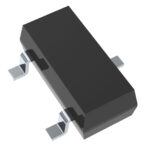 DZ23C9V1-HE3-18
The activity of extra discounts on wholesale prices is in full swing…
Please fill in your contact information and we will send you the latest wholesale price list.




