 ChipApex | Global Electronic Components Supplier
SEARCH
Search Product
Search Post
— IC芯片 | 连接器 | 传感器 | 被动器件 —
Search productSearch post
— IC芯片 | 连接器 | 传感器 | 被动器件 —
Consult the customer manager about the wholesale price.
consultation hotline:86-132-6715-2157
email:[email protected]
Contact the product manager for consultation. One-stop consultation is available.
Do you want a lower wholesale price? Please send us your inquiry and we will reply immediately.
The E-L9935 is a two-phase stepper motor driver circuit designed for bipolar stepper motors, controlled via a serial SPI interface. It features two full bridge outputs capable of delivering 1.1 A each, with integrated chopping current regulation to minimize power dissipation during flyback. The device includes output stages with controlled voltage slopes to reduce electromagnetic radiation and offers short-circuit protection for all outputs. Additional safety features include an error flag for overload, open load, and over-temperature pre-alarm, along with delayed channel switch-on to reduce peak currents. The maximum operating supply voltage is 24 V, with typical standby consumption of 40 μA.
Verify the component status as NRND (Not Recommended for New Designs) before procurement. Confirm that the specific package type and marking codes match your design requirements. Ensure compatibility with the 24 V maximum supply voltage and SPI communication protocol. Review the latest datasheet for any updates on pin configuration or thermal characteristics prior to finalizing orders.
Select this driver for applications requiring precise control of bipolar stepper motors with integrated safety features. Consider the 1.1 A output capability and 24 V supply limit when sizing the motor and power source. The integrated protections simplify system design by reducing external component count. Verify that the SPI interface timing meets the controller's requirements for reliable communication.
The L9935 series belongs to STMicroelectronics' portfolio of stepper motor drivers, designed for robust and efficient motor control. These devices integrate power stages and control logic to simplify system architecture. The E-L9935 variant typically denotes a specific package or temperature grade within the family, maintaining core functional specifications while addressing manufacturing or environmental constraints.
As the L9935 is marked NRND, evaluate alternative stepper motor drivers from STMicroelectronics or other manufacturers. Ensure substitutes support bipolar stepper motors, offer comparable current ratings, and provide similar protection features. Verify pin-to-pin compatibility if direct replacement is required to minimize redesign efforts.
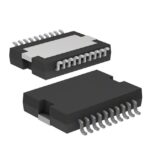 E-L9935
The activity of extra discounts on wholesale prices is in full swing…
Please fill in your contact information and we will send you the latest wholesale price list.





