 ChipApex | Global Electronic Components Supplier
SEARCH
Search Product
Search Post
— IC芯片 | 连接器 | 传感器 | 被动器件 —
Search productSearch post
— IC芯片 | 连接器 | 传感器 | 被动器件 —
Consult the customer manager about the wholesale price.
consultation hotline:86-132-6715-2157
email:[email protected]
Contact the product manager for consultation. One-stop consultation is available.
Do you want a lower wholesale price? Please send us your inquiry and we will reply immediately.
The ECSTA1V1308-1100-R is a surface-mount current sense transformer from Eaton Electronics, designed for high-frequency applications. It features a turns ratio of 100:1 and supports primary currents up to 15 A. The device operates within a frequency range of 50 kHz to 1 MHz. Key electrical specifications include a maximum inductance of 5.6 mH, a primary resistance of 3.9 mOhm, and a secondary resistance of 2 Ohm. It is qualified under the AEC-Q200 standard and functions reliably across an operating temperature range of -40°C to +125°C.
Verify that the specific part number suffix matches the required turns ratio and packaging configuration. Confirm that the supplier provides official documentation confirming AEC-Q200 compliance. Ensure the procurement channel is authorized to guarantee component authenticity and traceability. Check for any recent engineering change notices that might affect mechanical or electrical parameters before finalizing orders.
Select this component when a 100:1 isolation ratio is required for primary-side current measurement in high-current DC circuits. The 15 A rating suits applications with significant load currents. Consider the 5.6 mH inductance value to ensure adequate signal fidelity at the target switching frequency. Verify that the SMD footprint aligns with the existing PCB layout constraints and thermal management requirements.
This component belongs to the ECST1V1308 series of current sense transformers manufactured by Eaton Electronics. The series utilizes a standardized core size designated by the '1308' code, ensuring consistent mechanical dimensions across various turns ratios. This specific model represents a high-ratio variant intended for precise low-current secondary signal generation from high primary currents.
Direct substitutes within the same Eaton series include ECST1V1308-1040-R (40:1 ratio) and ECST1V1308-1060-R (60:1 ratio). Other variants such as ECST1V1308-1125-R offer different ratios but share identical physical footprints. Cross-vendor replacements require careful validation of inductance, resistance, and saturation characteristics to maintain circuit performance.
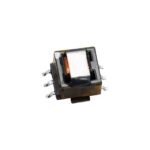 ECSTA1V1308-1100-R
The activity of extra discounts on wholesale prices is in full swing…
Please fill in your contact information and we will send you the latest wholesale price list.





