 ChipApex | Global Electronic Components Supplier
SEARCH
Search Product
Search Post
— IC芯片 | 连接器 | 传感器 | 被动器件 —
Search productSearch post
— IC芯片 | 连接器 | 传感器 | 被动器件 —
Consult the customer manager about the wholesale price.
consultation hotline:86-132-6715-2157
email:[email protected]
Contact the product manager for consultation. One-stop consultation is available.
Do you want a lower wholesale price? Please send us your inquiry and we will reply immediately.
The CESYS EFM-01 is a compact embedded FPGA module measuring 45x30x15mm, integrating a Xilinx Spartan-3E XC3S500E-4CPG132C and a Cypress CY7C68013A USB 2.0 controller. The module provides 50 accessible I/O balls via standard 0.1-inch headers. It supports configuration through USB 2.0, JTAG, or onboard SPI Flash. Power can be supplied via the USB bus or an external 5V source, with current limits of 500mA in bus-powered mode and 1000mA in self-powered mode.
Verify that the specific order includes the USB cable and user manual as part of the standard delivery scope. Confirm compatibility with the required host software API for USB communication. Ensure the design constraints align with the 48MHz onboard clock frequency provided by the module.
Select this module if a small form factor with integrated USB connectivity is required for Spartan-3E development. Consider the 50 available I/O pins against the total pin count of the CPG132 package. Verify that the 3.3V signaling level on all I/O banks meets the voltage requirements of the target peripheral devices.
The EFM-01 serves as a development platform for the Xilinx Spartan-3E family, specifically utilizing the XC3S500E device. It bridges FPGA logic with host computers via the Cypress FX2 LP USB controller, enabling direct bitstream loading and data exchange without external programmers when configured correctly.
No direct replacement parts are documented. Alternative solutions would require redesigning the USB interface and FPGA selection, as the EFM-01 integrates specific legacy components (XC3S500E and CY7C68013A) not commonly found in modern modules.
The default configuration mode is booting from the onboard SPI Flash using SPI Master mode. If no valid design is stored, configuration must be performed via JTAG or USB.
In bus-powered mode, the 3.3VCCO output is limited to 500mA. In self-powered mode, it is limited by the external power supply but should not exceed 1000mA.
No, the EFM-01 does not support short packets. The PKTEND# signal must be statically set to HIGH, and dummy data should be added to meet 512-byte alignment requirements.
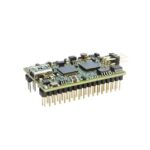 EFM-01
The activity of extra discounts on wholesale prices is in full swing…
Please fill in your contact information and we will send you the latest wholesale price list.






