 ChipApex | Global Electronic Components Supplier
SEARCH
Search Product
Search Post
— IC芯片 | 连接器 | 传感器 | 被动器件 —
Search productSearch post
— IC芯片 | 连接器 | 传感器 | 被动器件 —
Consult the customer manager about the wholesale price.
consultation hotline:86-132-6715-2157
email:[email protected]
Contact the product manager for consultation. One-stop consultation is available.
Do you want a lower wholesale price? Please send us your inquiry and we will reply immediately.
The Everlight EL3023S(TA) is a Triac and SCR output optocoupler designed for surface-mount applications. It features a single channel with a PhotoTriac output, providing robust electrical isolation via a 5000 Vrms insulation voltage. The device operates within a temperature range of -55°C to +100°C and supports a peak repetitive off-state voltage (VDRM) of 400 V. Key electrical parameters include a maximum DC forward current (If) of 60 mA, a typical forward voltage (Vf) of 1.18 V, and a maximum trigger current (Ift) of 5 mA. Power dissipation is rated at 330 mW, ensuring reliable performance in random-phase triac driver circuits.
Verify the specific suffix variant required for your design, as packaging options such as cut tape or reel may vary by distributor. Confirm that the selected component meets all relevant safety certifications including UL, VDE, and CSA for your target market. Ensure that the surface-mount footprint matches your PCB layout specifications before finalizing orders.
Select this component when random-phase triggering is required rather than zero-crossing switching. Consider the 400 V blocking voltage limit for load compatibility. Evaluate the thermal management requirements given the 330 mW power dissipation rating. Verify that the 5000 Vrms isolation level meets the safety standards applicable to the equipment being designed.
This part belongs to the EL302X series of optocouplers manufactured by Everlight Electronics. The series includes various package configurations and voltage ratings tailored for different industrial and consumer applications. The EL3023S(TA) specifically addresses the need for compact, surface-mount solutions in AC power control environments requiring moderate isolation voltages.
Direct substitutes include the EL3023S1(TA)-V and ELM3023(TB). Verify pinout compatibility and electrical parameter equivalence before substitution. Note that suffix variations may indicate differences in packaging or specific manufacturing batches rather than functional changes.
No, this component is designed for random-phase triggering and does not incorporate a zero-crossing detection circuit.
The device is rated for operation up to a maximum temperature of +100°C.
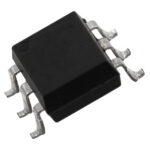 EL3023S(TA)
The activity of extra discounts on wholesale prices is in full swing…
Please fill in your contact information and we will send you the latest wholesale price list.




