ChipApex | Global Electronic Components Supplier
SEARCH
Search Product
Search Post
— IC芯片 | 连接器 | 传感器 | 被动器件 —
Search productSearch post
— IC芯片 | 连接器 | 传感器 | 被动器件 —
Consult the customer manager about the wholesale price.
consultation hotline:86-132-6715-2157
email:[email protected]
Contact the product manager for consultation. One-stop consultation is available.
Do you want a lower wholesale price? Please send us your inquiry and we will reply immediately.
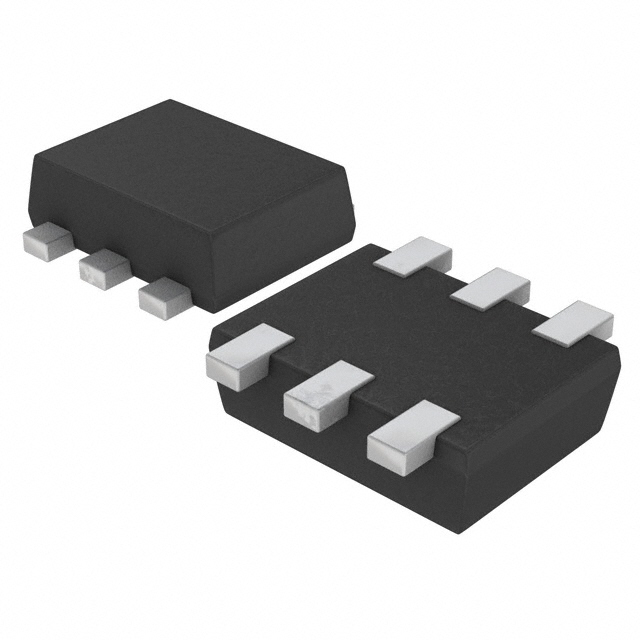
The EMD3T2R is a dual digital transistor from ROHM Semiconductor, integrating one NPN and one PNP bipolar junction transistor within a compact SOT-563 (EMT6) surface-mount package. This component features built-in bias resistors to simplify circuit design by eliminating the need for external input components. Key electrical specifications include a maximum collector-emitter voltage of 50V for the NPN side and -50V for the PNP side, with continuous collector currents rated at 100mA and -100mA respectively. The device offers a minimum DC current gain (hFE) of 30 under standard test conditions and supports a transition frequency up to 250MHz. It operates within a temperature range of -55°C to +150°C and has a power dissipation rating of 150mW.
Verify the specific suffix T2R confirms the tape-and-reel packaging format containing 8000 units per reel. Confirm RoHS compliance status through official documentation before integration. Check for any obsolescence notices or lifecycle changes directly from the manufacturer. Ensure the ordering code matches the required resistance values and polarity configuration.
Select this component when space constraints require a dual-transistor solution with integrated biasing. Compare against single-transistor alternatives like DTA114E or DTC114E if only one polarity is needed. Verify that the 50V breakdown voltage and 100mA current ratings meet the specific load requirements of the target application circuit.
The EMD3T2R belongs to the EMD series of complex transistors designed for general-purpose switching and amplification. It serves as a compact alternative to discrete resistor-transistor networks, reducing board space and assembly complexity. The EMT6 package provides a standardized footprint compatible with automated surface-mount placement processes.
Direct functional equivalents may include other dual NPN/PNP digital transistors in SOT-563 packages from various manufacturers. Verify pinout compatibility and electrical parameter margins before substitution. Single-transistor replacements require additional external biasing resistors.
 EMD3T2R
The activity of extra discounts on wholesale prices is in full swing…
Please fill in your contact information and we will send you the latest wholesale price list.