 ChipApex | Global Electronic Components Supplier
SEARCH
Search Product
Search Post
— IC芯片 | 连接器 | 传感器 | 被动器件 —
Search productSearch post
— IC芯片 | 连接器 | 传感器 | 被动器件 —
Consult the customer manager about the wholesale price.
consultation hotline:86-132-6715-2157
email:[email protected]
Contact the product manager for consultation. One-stop consultation is available.
Do you want a lower wholesale price? Please send us your inquiry and we will reply immediately.
The EMX1DXV6T1G is a dual NPN bipolar junction transistor (BJT) array manufactured by onsemi. It features a maximum collector current of 100 mA and a collector-emitter voltage rating of 50 V, with a collector-base voltage of 60 V and an emitter-base voltage of 7 V. The device operates within a temperature range of -55°C to +150°C TJ. Key electrical parameters include a minimum DC current gain (hFE) of 120 at 1 mA and 6 V, a transition frequency (fT) of 180 MHz, and a collector-emitter saturation voltage of 400 mV at specified currents. Power dissipation is rated at 357 mW. The component is housed in a SOT-563-6 surface-mount package.
Verify the RoHS compliance status through official manufacturer documentation or certified datasheets prior to integration. Confirm that the specific orderable part number matches the required pinout and electrical specifications. Ensure that sourcing channels provide valid traceability records. Cross-reference the latest product change notices to confirm manufacturing continuity and material consistency for the intended production volume.
Select this component when a dual NPN topology is required in a small outline package. Compare the 50 V collector-emitter voltage against circuit supply rails to ensure adequate headroom. Evaluate the 100 mA continuous collector current limit against peak load requirements. Consider the 357 mW power dissipation rating and thermal resistance characteristics for PCB layout planning under expected operating conditions.
This device belongs to the EMX1 series of dual bipolar transistors from onsemi. It serves as the lead-free, RoHS-compliant successor to the discontinued EMX1DXV6T1. The 'G' suffix indicates environmental compliance. It shares the same functional pinout and electrical characteristics as its non-compliant predecessor, facilitating direct replacement in existing designs requiring updated regulatory standards.
The EMX1DXV6T1G is the direct compliant replacement for the obsolete EMX1DXV6T1. Both parts share identical electrical specifications and pin configurations. Verify that the legacy design does not rely on specific non-RoHS materials present in the older variant.
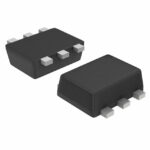 EMX1DXV6T1G
The activity of extra discounts on wholesale prices is in full swing…
Please fill in your contact information and we will send you the latest wholesale price list.




