ChipApex | Global Electronic Components Supplier
SEARCH
Search Product
Search Post
— IC芯片 | 连接器 | 传感器 | 被动器件 —
Search productSearch post
— IC芯片 | 连接器 | 传感器 | 被动器件 —
Consult the customer manager about the wholesale price.
consultation hotline:86-132-6715-2157
email:[email protected]
Contact the product manager for consultation. One-stop consultation is available.
Do you want a lower wholesale price? Please send us your inquiry and we will reply immediately.
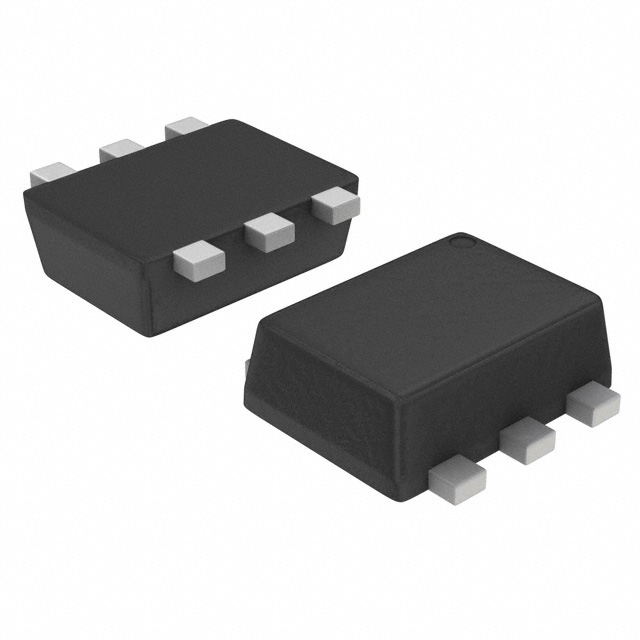
The EMX1DXV6T5G is a dual NPN bipolar junction transistor (BJT) array manufactured by onsemi. It features a maximum DC collector current of 100 mA and a collector-emitter voltage (VCEO) of 50 V, with a collector-base voltage (VCBO) of 60 V. The device operates within a temperature range of -55°C to +150°C TJ. Key electrical parameters include a transition frequency (fT) of 180 MHz, a minimum DC current gain (hFE) of 120 at 1 mA and 6 V, and a power dissipation rating of 357 mW. It is housed in an SOT-563-6 surface-mount package.
Verify the suffix 'G' indicates RoHS compliance. Confirm availability status as the non-G version may be obsolete. Ensure the specific reel or cut-tape packaging matches production requirements. Validate that the SOT-563 footprint aligns with the target PCB design before ordering.
Select this component when a dual NPN solution is required in a minimal footprint. Compare fT and hFE specifications against circuit speed and gain requirements. Ensure the 50V VCEO rating exceeds the maximum operating voltage. Verify thermal management capabilities for the intended power dissipation levels.
This part belongs to the EMX1 series of dual BJT arrays from onsemi. It serves as a modern, lead-free replacement for older non-compliant variants like the EMX1DXV6T1. The SOT-563 package allows for automated assembly and reduced board space compared to discrete components.
The EMX1DXV6T1G is a direct functional equivalent with RoHS compliance. Other dual NPN transistors in SOT-563 packages may serve as alternatives if pinouts and electrical ratings match exactly.
The EMX1DXV6T1G is the RoHS-compliant version of the obsolete EMX1DXV6T1. They share identical electrical characteristics and pinouts.
The datasheet specifies typical internal base resistors, but exact values depend on the specific variant within the EMX1 family. Consult the official datasheet for precise resistor values.
With a transition frequency (fT) of 180 MHz, it is suitable for moderate-speed digital switching and small-signal amplification, but not for RF applications.
 EMX1DXV6T5
The activity of extra discounts on wholesale prices is in full swing…
Please fill in your contact information and we will send you the latest wholesale price list.