 ChipApex | Global Electronic Components Supplier
SEARCH
Search Product
Search Post
— IC芯片 | 连接器 | 传感器 | 被动器件 —
Search productSearch post
— IC芯片 | 连接器 | 传感器 | 被动器件 —
Consult the customer manager about the wholesale price.
consultation hotline:86-132-6715-2157
email:[email protected]
Contact the product manager for consultation. One-stop consultation is available.
Do you want a lower wholesale price? Please send us your inquiry and we will reply immediately.
The Altera EP20K100EQC208-3N is a Field Programmable Gate Array (FPGA) belonging to the APEX 20KE family. It features a MultiCore architecture integrating look-up table (LUT) logic, product-term logic, and embedded memory. The device provides 4,160 logic elements (LEs), 53,248 maximum RAM bits, and 416 macrocells. It operates at an internal supply voltage of 1.8 V with MultiVolt I/O support for 1.8-V, 2.5-V, 3.3-V, and 5.0-V levels. Packaged in a 208-pin Plastic Quad Flat Package (PQFP), it supports up to 246 user I/O pins and includes four phase-locked loops (PLLs).
Verify component authenticity through official Altera documentation channels. Confirm package integrity and pin alignment for the 208-pin PQFP form factor. Ensure design files are compatible with the Quartus II development system. Check for moisture sensitivity handling requirements prior to assembly. Validate that the specific speed grade (-3) meets timing constraints for the target application frequency.
Select this model when designs require 4,160 LEs and significant embedded memory capacity within a QFP package. Compare against EP20K100E variants if higher gate counts or different pinouts are needed. Consider the -3 speed grade for applications requiring specific timing performance. Evaluate power consumption profiles given the 1.8-V core voltage requirement. Ensure the 208-pin footprint aligns with existing PCB layout constraints.
This component is part of the APEX 20KE series, representing an evolution of the original APEX 20K family with enhanced I/O standards and memory features. It utilizes a 0.15-µm copper-metal fabrication process. The device is designed for reconfigurable computing and supports in-system programmability via serial configuration devices like EPC1 or EPC2. It serves as a bridge between traditional CPLDs and high-end FPGAs.
Direct pin-compatible replacements within the same package include other APEX 20K devices such as the EP20K60EQC208 or EP20K200EQC208, subject to logic resource availability. Verify electrical characteristics and speed grades match the original design requirements. Consult Altera documentation for migration guides from APEX 20K to newer FPGA families if obsolescence is a concern.
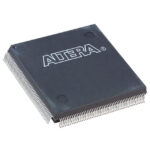 EP20K100EQC208-3N
The activity of extra discounts on wholesale prices is in full swing…
Please fill in your contact information and we will send you the latest wholesale price list.






