 ChipApex | Global Electronic Components Supplier
SEARCH
Search Product
Search Post
— IC芯片 | 连接器 | 传感器 | 被动器件 —
Search productSearch post
— IC芯片 | 连接器 | 传感器 | 被动器件 —
Consult the customer manager about the wholesale price.
consultation hotline:86-132-6715-2157
email:[email protected]
Contact the product manager for consultation. One-stop consultation is available.
Do you want a lower wholesale price? Please send us your inquiry and we will reply immediately.
The FAN7930BMX-G is a critical conduction mode (CRM) power factor correction controller from onsemi, designed for boost PFC applications. It utilizes voltage-mode PWM control, comparing an internal ramp signal with the error amplifier output to generate MOSFET turn-off signals. This architecture eliminates the need for rectified AC line voltage sensing, reducing input network power loss. The device integrates comprehensive protection features including overvoltage protection (OVP), open-loop feedback protection, overcurrent protection (OCP), undervoltage lockout (UVLO), and input voltage missing detection. It employs a variable on-time control method to achieve total harmonic distortion (THD) lower than traditional CRM controllers.
Verify the specific suffix 'BMX-G' against the official onsemi datasheet to confirm package type and tape-and-reel specifications. Ensure compatibility with the required operating temperature range and pin configuration for your PCB layout. Cross-reference the ordering part number with the manufacturer's latest documentation to avoid discrepancies in revision levels or packaging quantities.
Select this component for designs prioritizing low harmonic distortion without the complexity of current-mode sensing networks. The voltage-mode control approach reduces component count and power loss associated with input voltage sensing. Consider the integrated protections and soft-start features for robust system reliability. Verify that the application does not require continuous conduction mode operation, as the device is optimized for critical conduction mode.
The FAN7930B belongs to onsemi's family of CRM PFC controllers, designed to replace traditional current-mode solutions. It offers improved THD performance and simplified design through integrated optimization features. The device is suitable for applications demanding high power factor and low electromagnetic interference. Its voltage-mode control strategy provides a distinct advantage in efficiency and component reduction compared to conventional architectures.
Check for direct pin-to-pin replacements within the FAN7930 series, such as the FAN7930C, ensuring functional equivalence in control mode and protection features. Verify that any substitute maintains the same voltage-mode PWM characteristics and CRM operation requirements. Confirm that the alternative device supports the necessary switching frequency limits and protection thresholds for the specific application.
It includes an OVP pin that performs a secondary check if the INV pin information is inaccurate, preventing output capacitor damage. Additionally, an internal comparator disables the chip if the INV pin voltage drops below 0.45 V.
The device uses voltage-mode PWM control, which compares an internal ramp signal with the error amplifier output to generate the MOSFET turn-off signal, eliminating the need for input voltage sensing.
No, it features an internal THD optimizer that removes the need for external resistors, simplifying the circuit design while achieving lower total harmonic distortion than traditional CRM controllers.
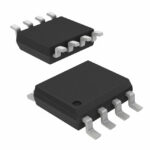 FAN7930BMX-G
The activity of extra discounts on wholesale prices is in full swing…
Please fill in your contact information and we will send you the latest wholesale price list.





