ChipApex | Global Electronic Components Supplier
SEARCH
Search Product
Search Post
— IC芯片 | 连接器 | 传感器 | 被动器件 —
Search productSearch post
— IC芯片 | 连接器 | 传感器 | 被动器件 —
Consult the customer manager about the wholesale price.
consultation hotline:86-132-6715-2157
email:[email protected]
Contact the product manager for consultation. One-stop consultation is available.
Do you want a lower wholesale price? Please send us your inquiry and we will reply immediately.
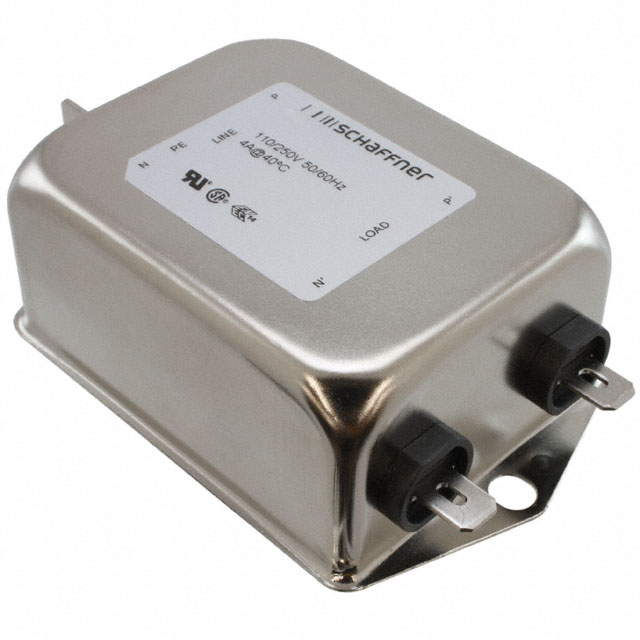
The Schaffner FN2090NN-3-06 is a single-phase, two-stage EMI power line filter designed for chassis mounting. It supports a maximum current of 3 A and operates at voltages up to 250 V AC/DC within a frequency range of 0 Hz to 400 Hz. The component utilizes faston quick-connect terminals for circuit integration. Key electrical parameters include an inductance of 14 mH, capacitance of 330 nF, and a leakage current of 0.002 mA. It features a built-in discharge resistor of 470 kΩ. The unit functions reliably within an operating temperature range of -25°C to +100°C.
Verify the specific suffix code against official TE Connectivity / Schaffner documentation to confirm terminal type and mounting style. Ensure the application voltage does not exceed the 250 V rating. Confirm that the 3 A current capacity meets the load requirements. Check for required regulatory certifications such as UL or IEC depending on the target market. Validate physical dimensions for chassis compatibility before procurement.
Select this model when a compact, single-phase solution is required for low-current applications. The two-stage design offers superior attenuation compared to single-stage alternatives. Consider the faston connection type for ease of assembly in controlled environments. Evaluate the leakage current specification if safety isolation is critical. Compare thermal performance against ambient operating conditions to ensure reliability within the specified temperature range.
This component belongs to the FN2090 series, which provides general-purpose EMI filtering for single-phase AC and DC lines. The series is characterized by its robust construction and compliance with international EMC standards. It serves as a standard interface between power sources and sensitive electronic loads to prevent conducted noise propagation.
Consult official manufacturer substitution guides for verified equivalents. Cross-reference pinouts and electrical ratings carefully. Ensure mechanical mounting holes align with existing chassis designs. Verify that any substitute part maintains the same two-stage filtering topology and leakage current characteristics.
 FN2090NN-3-06
The activity of extra discounts on wholesale prices is in full swing…
Please fill in your contact information and we will send you the latest wholesale price list.