ChipApex | Global Electronic Components Supplier
SEARCH
Search Product
Search Post
— IC芯片 | 连接器 | 传感器 | 被动器件 —
Search productSearch post
— IC芯片 | 连接器 | 传感器 | 被动器件 —
Consult the customer manager about the wholesale price.
consultation hotline:86-132-6715-2157
email:[email protected]
Contact the product manager for consultation. One-stop consultation is available.
Do you want a lower wholesale price? Please send us your inquiry and we will reply immediately.
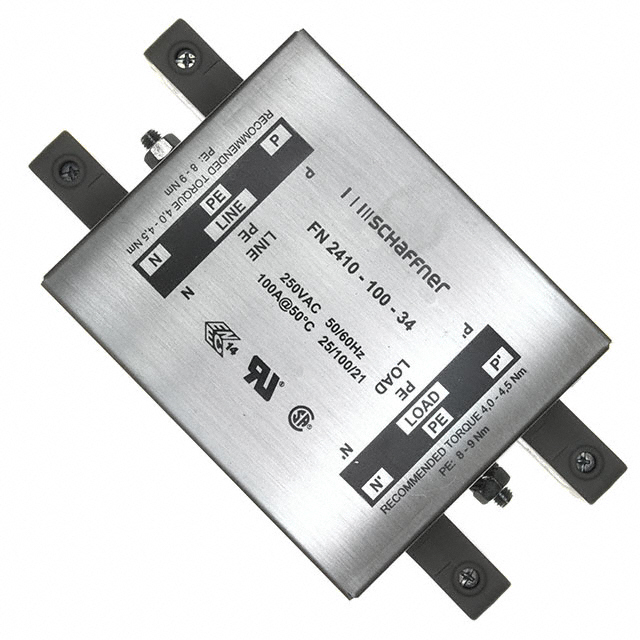
The Schaffner FN2410-100-34 is a single-phase EMC/EMI power line filter designed for chassis mounting. It features terminal block input and output connections. The unit supports a rated current of 100 A at 250 VAC. It operates within a frequency range of 0 Hz to 400 Hz. The device has a leakage current of 2.6 mA. It functions in temperatures from -25°C to +100°C. Certifications include UL, CSA, and IEC/EN standards.
Verify the exact part number FN2410-100-34 against official TE Connectivity or Schaffner documentation before procurement. Confirm that the voltage rating of 250 VAC and current capacity of 100 A match your specific circuit requirements. Ensure compatibility with chassis mounting dimensions and terminal block specifications. Check for updated certification status such as UL, CSA, and IEC/EN compliance relevant to your region. Validate lead times and production cycles directly with authorized distributors.
Select this component when single-phase filtering is required for currents up to 100 A. Ensure the operating environment temperature falls between -25°C and +100°C. Verify that the 250 VAC rating suits the system voltage. Confirm that chassis mounting is feasible for the installation site. Check that terminal block termination aligns with existing wiring infrastructure. Consider leakage current limits if sensitive to ground fault issues.
This component belongs to the Schaffner FN2410 series of power line filters. The series offers various current ratings and configurations for different industrial needs. The FN2410-100-34 specifically addresses high-current single-phase applications. It is manufactured by TE Connectivity under the Schaffner brand. The product focuses on robust EMI suppression in demanding environments.
Consult official TE Connectivity substitution guides for verified alternatives. Cross-reference technical specifications including current, voltage, and dimensions. Ensure any substitute maintains equivalent certification approvals. Verify physical mounting compatibility before replacement.
 FN2410-100-34
The activity of extra discounts on wholesale prices is in full swing…
Please fill in your contact information and we will send you the latest wholesale price list.