 ChipApex | Global Electronic Components Supplier
SEARCH
Search Product
Search Post
— IC芯片 | 连接器 | 传感器 | 被动器件 —
Search productSearch post
— IC芯片 | 连接器 | 传感器 | 被动器件 —
Consult the customer manager about the wholesale price.
consultation hotline:86-132-6715-2157
email:[email protected]
Contact the product manager for consultation. One-stop consultation is available.
Do you want a lower wholesale price? Please send us your inquiry and we will reply immediately.
The Forlinx Embedded FET-MX9352-C is an industrial System-on-Module (SoM) based on the NXP i.MX9352 processor. It features a heterogeneous multi-core architecture with dual Cortex-A55 cores operating at 1.7GHz and a single Cortex-M33 real-time core running at 250MHz. The module integrates an Arm Ethos U65 microNPU providing 0.5 TOPS of AI acceleration. Standard configuration includes 1GB LPDDR4 RAM and 8GB eMMC storage. Designed for harsh environments, it utilizes industrial-grade components to support operation from -40°C to +85°C. The compact 48×33mm form factor connects via a 2×100-pin board-to-board connector.
Verify the specific revision level of the i.MX9352 SoC, as commercial and industrial variants may differ in clock speeds. Confirm that the carrier board design accommodates the 2×100-pin connector specifications (0.4mm pitch, 1.5mm height). Ensure software development environments align with the supported Linux kernel versions (5.15.52 or 6.1.36) and Qt frameworks provided by the manufacturer.
Select this module when deterministic real-time control is required alongside complex Linux-based applications, leveraging the separate Cortex-M33 core. It is suitable for space-constrained designs due to its 48×33mm footprint. Consider the 0.5 TOPS NPU capability if lightweight inference models are needed. Verify thermal management requirements for the -40°C to +85°C range if deploying in enclosed industrial enclosures.
This module is part of the FET series from Forlinx Embedded, designed around the NXP i.MX 93x processor family. The i.MX9352 represents a crossover processor combining application processing with real-time control. The product line emphasizes long-term supply stability, with NXP committing to a 15-year lifecycle for the underlying silicon.
For higher performance needs within the same ecosystem, consider the FET-MX9596-C, which features six Cortex-A55 cores and a Cortex-M7 core. For simpler single-core applications, the FETMX91xx-C series offers a Cortex-A55 solution. Cross-compatibility with carrier boards requires verification of pin mapping differences between the 100-pin connector standards used across different Forlinx modules.
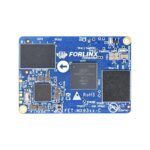 FORLINX-FETMX9352-C+151GSE8GIB11
The activity of extra discounts on wholesale prices is in full swing…
Please fill in your contact information and we will send you the latest wholesale price list.




