 ChipApex | Global Electronic Components Supplier
SEARCH
Search Product
Search Post
— IC芯片 | 连接器 | 传感器 | 被动器件 —
Search productSearch post
— IC芯片 | 连接器 | 传感器 | 被动器件 —
Consult the customer manager about the wholesale price.
consultation hotline:86-132-6715-2157
email:[email protected]
Contact the product manager for consultation. One-stop consultation is available.
Do you want a lower wholesale price? Please send us your inquiry and we will reply immediately.
The GBJ604 is a single-phase bridge rectifier manufactured by SMC Diode Solutions, designed for surface-mount applications in the GBJ package. It features a maximum repetitive peak reverse voltage of 400 V and an average forward rectified current rating of 6 A. The device utilizes standard silicon planar technology with a molded epoxy case that meets UL flammability classification 94V-0. Key electrical characteristics include a maximum non-repetitive peak surge forward current capability and a low forward voltage drop to ensure efficient power conversion.
Verify the specific manufacturer part number against official SMC Diode Solutions documentation to confirm pinout compatibility and thermal specifications. Ensure that the procurement source provides valid RoHS compliance certificates and material safety data sheets. Cross-reference the datasheet revision history to confirm that the supplied components match the latest engineering standards and packaging requirements.
Select this component when a robust surface-mount solution is required for medium-current applications up to 6 A. The 400 V reverse voltage rating makes it suitable for universal input AC lines. Consider the thermal resistance of the GBJ package and the need for adequate PCB copper area for heat dissipation during continuous operation under full load conditions.
The GBJ604 belongs to the GBJ series of bridge rectifiers from SMC Diode Solutions, which are widely used in compact electronic designs. This series offers a balance of high current handling and reliable performance in a standardized surface-mount footprint. It serves as a fundamental building block for converting alternating current to direct current in various consumer and industrial electronics.
Compatible substitutes include other 6 A, 400 V single-phase bridge rectifiers in the GBJ package, such as those from Littelfuse or Vishay. Verify that alternative parts match the exact pin configuration, forward voltage characteristics, and thermal performance to ensure seamless integration without redesigning the printed circuit board layout.
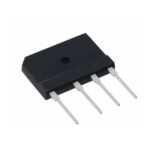 GBJ604
The activity of extra discounts on wholesale prices is in full swing…
Please fill in your contact information and we will send you the latest wholesale price list.





