ChipApex | Global Electronic Components Supplier

SEARCH
Search Product
Search Post
— IC芯片 | 连接器 | 传感器 | 被动器件 —
Search productSearch post
— IC芯片 | 连接器 | 传感器 | 被动器件 —
Consult the customer manager about the wholesale price.
consultation hotline:86-132-6715-2157
email:[email protected]
Contact the product manager for consultation. One-stop consultation is available.
Do you want a lower wholesale price? Please send us your inquiry and we will reply immediately.
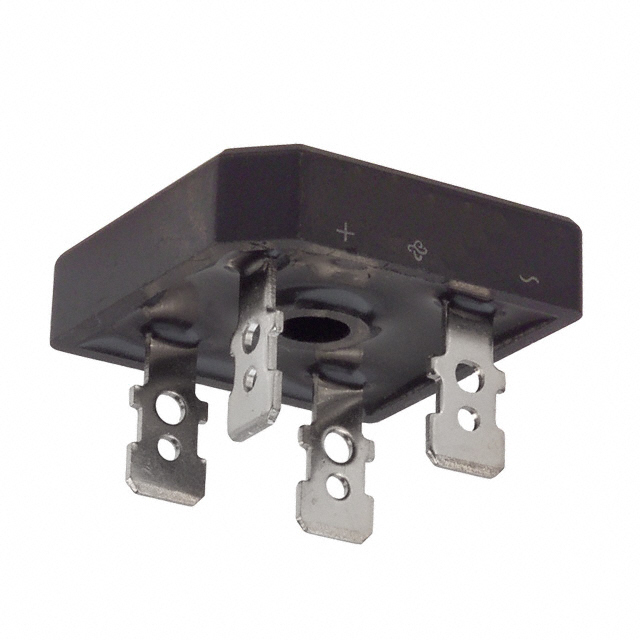
The Vishay GBPC15005-E4/51 is a glass passivated single-phase bridge rectifier from the GBPC15 series. It provides a maximum average forward rectified output current (IF(AV)) of 15 A and a maximum repetitive peak reverse voltage (VRRM) of 50 V. The device features a peak forward surge current capability (IFSM) of 300 A for non-repetitive half-sine waves exceeding 1 ms. Electrical characteristics include a typical instantaneous forward drop (VF) of 1.1 V at 7.5 A, a maximum reverse DC current (IR) of 5 μA at 25 °C, and a junction capacitance (CJ) of 160 pF. Thermal resistance (RθJC) is rated at 1.9 °C/W. Operating and storage temperature ranges span from -55 °C to +150 °C.
Verify component authenticity by checking manufacturer markings against official datasheet specifications. Confirm compliance with RoHS directives and UL recognition file E54214. Ensure procurement channels provide original packaging to prevent counterfeit components. Validate terminal plating and physical dimensions match the GBPC outline before integration into production assemblies.
Select this component when a 15 A continuous current rating and 50 V blocking voltage are required. Verify that the 300 A surge capacity meets circuit fault tolerance requirements. Ensure the operating environment remains within the specified -55 °C to +150 °C temperature range. Confirm that the 1.9 °C/W thermal resistance allows adequate heat dissipation without excessive heatsinking.
This part belongs to the Vishay GBPC15 series of single-phase bridge rectifiers. The series offers standardized electrical ratings across multiple voltage options, ranging from 50 V to 1000 V. All variants share identical physical dimensions and mounting configurations, facilitating design flexibility while maintaining consistent thermal and mechanical performance characteristics across different voltage requirements.
Cross-reference with other GBPC15 series variants such as GBPC1501-E4/51 or GBPC1502-E4/51 if higher voltage ratings are needed. Verify that substitute components maintain identical IF(AV), IFSM, and package dimensions. Ensure replacement parts meet the same UL recognition and RoHS compliance standards.
 GBPC15005-E4/51

The activity of extra discounts on wholesale prices is in full swing…
Please fill in your contact information and we will send you the latest wholesale price list.