ChipApex | Global Electronic Components Supplier

SEARCH
Search Product
Search Post
— IC芯片 | 连接器 | 传感器 | 被动器件 —
Search productSearch post
— IC芯片 | 连接器 | 传感器 | 被动器件 —
Consult the customer manager about the wholesale price.
consultation hotline:86-132-6715-2157
email:[email protected]
Contact the product manager for consultation. One-stop consultation is available.
Do you want a lower wholesale price? Please send us your inquiry and we will reply immediately.
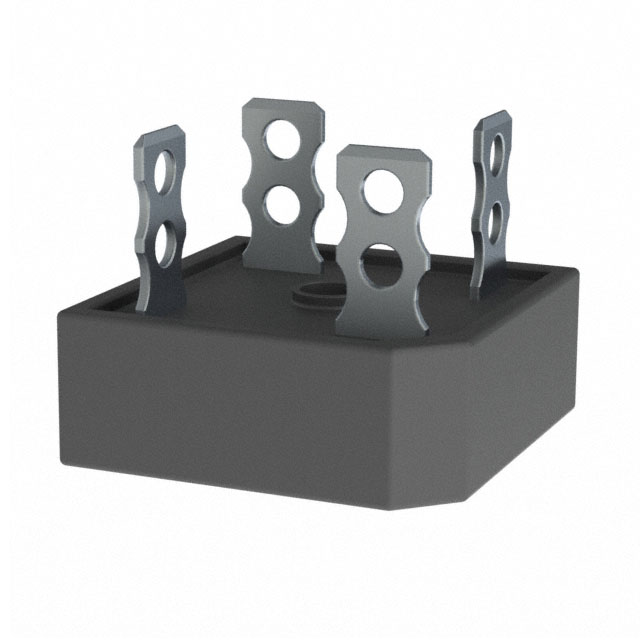
The GBPC25005M is a single-phase bridge rectifier from the Taiwan Semiconductor GBPC15, 25, 35 Series. It features an average forward current (IF) of 25 A and a repetitive peak reverse voltage (VRRM) of 50 V. The device utilizes glass passivated chip junctions and includes an integrally molded heatsink for thermal management. Key electrical specifications include a maximum forward voltage of 1.1 V at 12.5 A, a typical reverse current of 5 µA, and a peak forward surge current (IFSM) of 300 A. The component operates within a junction temperature range of -55 °C to +150 °C.
Verify that the ordering code matches the specific suffix requirements for terminal configuration. Confirm RoHS compliance status and UL recognition file number E-326243 during sourcing. Ensure packaging details align with project needs, as standard trays contain fifty units per package. Cross-reference datasheet version M2211 for accurate technical parameters.
Select this component based on the required 25 A current rating and 50 V reverse voltage capability. Consider the GBPC-M variant specifically when parallel terminal alignment between cathode and anode is necessary for PCB layout optimization. Evaluate thermal resistance characteristics against system heat dissipation requirements to ensure reliable operation within the specified temperature limits.
This part belongs to the GBPC15, 25, 35 Series manufactured by Taiwan Semiconductor Corporation. The series offers standardized bridge rectifier solutions with varying current ratings and voltage options. The 'M' suffix denotes a specific mechanical variation where the terminal cathode is positioned parallel to the anode, distinguishing it from standard or wire-structure variants within the same family.
Compatible substitutes include other GBPC25005 variants from different manufacturers, such as those from Panjit or onsemi. Verify that replacement parts match the 25 A current rating, 50 V voltage rating, and GBPC package dimensions. Ensure equivalent thermal and electrical characteristics are maintained for direct integration.
 GBPC25005M

The activity of extra discounts on wholesale prices is in full swing…
Please fill in your contact information and we will send you the latest wholesale price list.