ChipApex | Global Electronic Components Supplier

SEARCH
Search Product
Search Post
— IC芯片 | 连接器 | 传感器 | 被动器件 —
Search productSearch post
— IC芯片 | 连接器 | 传感器 | 被动器件 —
Consult the customer manager about the wholesale price.
consultation hotline:86-132-6715-2157
email:[email protected]
Contact the product manager for consultation. One-stop consultation is available.
Do you want a lower wholesale price? Please send us your inquiry and we will reply immediately.
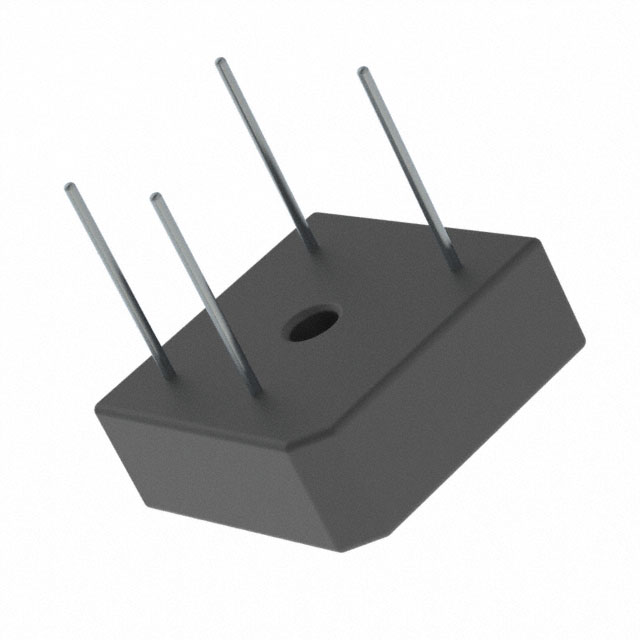
The onsemi GBPC2504W is a single-phase bridge rectifier from the GBPC25 series, rated for a maximum repetitive reverse voltage of 400 V and an average rectified forward current of 25 A at a case temperature of 55°C. It features a non-repetitive peak forward surge current capability of 300 A. The device utilizes a wire lead structure (suffix W) within a GBPC-W package, providing an isolated voltage from case to lead exceeding 2500 V. Electrical characteristics include a maximum forward voltage drop of 1.1 V at 12.5 A and a maximum reverse current of 5 µA at 25°C.
Verify the specific ordering suffix against the manufacturer's official documentation to ensure correct terminal configuration. Confirm that the component meets all required environmental standards and regulatory certifications relevant to the target application before finalizing procurement specifications.
Select this component based on the 400 V reverse voltage requirement and 25 A continuous current capacity. Ensure the PCB layout accommodates the GBPC-W package dimensions and allows for adequate airflow or heatsinking to maintain junction temperatures within the specified -55°C to +150°C operating range.
This part belongs to the onsemi GBPC 12, 15, 25, and 35 series of glass-passivated bridge rectifiers. The 'W' suffix specifically denotes a wire lead structure variant, distinguishing it from standard solder pin versions. These devices are designed for general-purpose applications requiring reliable rectification in compact packages.
Direct replacements must match the 400 V rating, 25 A current capacity, and GBPC-W package form factor. Verify that any substitute component maintains equivalent thermal resistance and surge current capabilities to ensure circuit reliability without redesigning the mounting or cooling infrastructure.
The 'W' suffix indicates that the device features a wire lead structure, as opposed to the standard solder pin configuration found in other variants of the GBPC series.
The device provides an isolated voltage from the case to the leads of over 2500 V, ensuring safety and electrical separation in high-voltage applications.
The thermal resistance from junction to case is 1.5 °C/W when mounted with a heatsink, facilitating effective heat dissipation under load.
 GBPC2504W

The activity of extra discounts on wholesale prices is in full swing…
Please fill in your contact information and we will send you the latest wholesale price list.