ChipApex | Global Electronic Components Supplier

SEARCH
Search Product
Search Post
— IC芯片 | 连接器 | 传感器 | 被动器件 —
Search productSearch post
— IC芯片 | 连接器 | 传感器 | 被动器件 —
Consult the customer manager about the wholesale price.
consultation hotline:86-132-6715-2157
email:[email protected]
Contact the product manager for consultation. One-stop consultation is available.
Do you want a lower wholesale price? Please send us your inquiry and we will reply immediately.
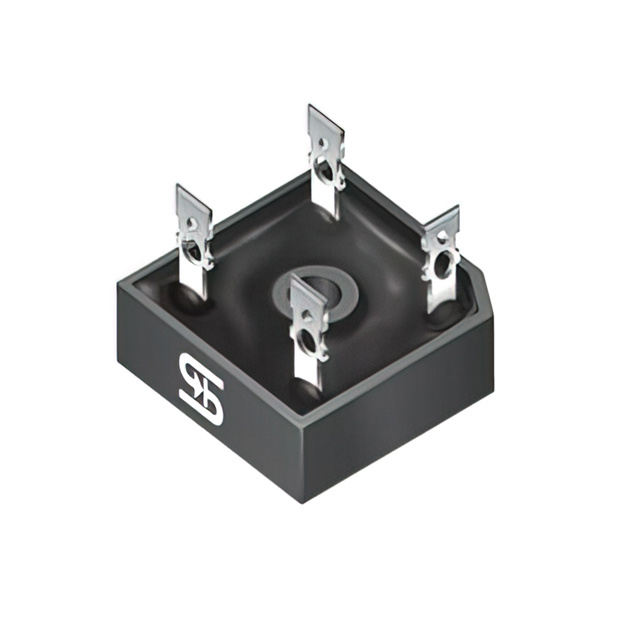
The GBPC5008 is a single-phase bridge rectifier manufactured by Taiwan Semiconductor Corporation. It features an average forward rectified current of 50A and a peak repetitive reverse voltage of 800V. The device utilizes glass passivated die construction to ensure low reverse leakage current and high efficiency with low power loss. It is housed in an electrically isolated epoxy case designed for maximum heat dissipation, providing a case-to-terminal isolation voltage of 2500V. The component operates within a junction temperature range of -55°C to +175°C and supports a non-repetitive peak forward surge current of 400A at 60Hz.
Verify the manufacturer part number against official Taiwan Semiconductor documentation to confirm specifications. Ensure the procurement channel provides valid traceability data. Check for RoHS compliance status as indicated in the specific product datasheet revision. Confirm package type matches the required GBPC form factor for PCB or chassis mounting compatibility.
Select this component when a 50A continuous current rating and 800V blocking voltage are required. The GBPC package offers robust mechanical stability for screw or board mounting. Consider the 400A surge capability for applications with high inrush currents. Verify thermal design requirements align with the isolated epoxy case capabilities for effective heat dissipation in enclosed environments.
The GBPC5008 belongs to the GBPC series of high-current single-phase bridge rectifiers from Taiwan Semiconductor. This series is engineered for general-purpose applications requiring reliable AC-to-DC conversion. The device shares the standard GBPC footprint with other variants in the family, differing primarily in voltage and current ratings. It serves as a fundamental building block in power electronics designs.
Cross-reference with equivalent 50A, 800V bridge rectifiers in the GBPC package from other manufacturers such as MIC GROUP RECTIFIERS or SeCoS Halbleitertechnol. Ensure pinout compatibility and thermal characteristics match the original design constraints before substitution.
 GBPC5008

The activity of extra discounts on wholesale prices is in full swing…
Please fill in your contact information and we will send you the latest wholesale price list.