 ChipApex | Global Electronic Components Supplier

SEARCH
Search Product
Search Post
— IC芯片 | 连接器 | 传感器 | 被动器件 —
Search productSearch post
— IC芯片 | 连接器 | 传感器 | 被动器件 —
Consult the customer manager about the wholesale price.
consultation hotline:86-132-6715-2157
email:[email protected]
Contact the product manager for consultation. One-stop consultation is available.
Do you want a lower wholesale price? Please send us your inquiry and we will reply immediately.
The MDD GBU1010 is a glass passivated single-phase bridge rectifier in the GBU series, designed for through-hole mounting. It features a molded plastic body with UL flammability classification 94V-0 and solder-plated terminals. The device supports a repetitive peak reverse voltage of 1000V and an average forward rectified current of 10A at Tc=100°C. Key electrical parameters include a peak forward surge current of 220A, a maximum forward voltage of 1.0V at 5.0A DC, and a thermal resistance (RθJA) of 2.2°C/W. Operating junction temperature ranges from -55°C to +150°C.
Verify that the component matches the original MDD specification sheet N0310-GBU1010000L10A. Confirm the package type is bulk with 500 pieces per box as indicated by the 'L' code. Ensure the marking on the body reads GBU1010 and check for RoHS/RoHS III compliance documentation before finalizing procurement orders.
Select this component when a 1000V rating and 10A continuous current are required for single-phase rectification. Consider the 220A surge capability for inrush protection. Verify thermal management requirements against the 2.2°C/W thermal resistance value if operating near the maximum junction temperature limit.
The GBU1010 belongs to the GBU series of glass passivated bridge rectifiers manufactured by MDD. This series covers various voltage and current ratings, ranging from lower amperage models like GBU0406 to higher capacity units like GBU2510. The GBU1010 specifically targets high-voltage, medium-current applications within this standardized through-hole family.
Cross-reference part numbers such as DiodesZetex GBU1010 or HY Electronic GBU1010 for potential substitutes. Verify that alternative manufacturers meet the same 1000V VRRM, 10A IAV, and GBU package dimensions to ensure mechanical and electrical compatibility.
The peak forward surge current (IFSM) is rated at 220A for an 8.3ms single half sine-wave superimposed on rated load.
For capacitive loads, the average forward rectified current must be derated by 20% compared to resistive or inductive loads.
The junction capacitance (CJ) is typically 70 pF, measured at 1MHz with an applied reverse voltage of 4.0V DC.
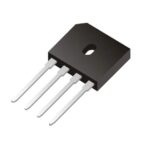 GBU1010

The activity of extra discounts on wholesale prices is in full swing…
Please fill in your contact information and we will send you the latest wholesale price list.






