ChipApex | Global Electronic Components Supplier

SEARCH
Search Product
Search Post
— IC芯片 | 连接器 | 传感器 | 被动器件 —
Search productSearch post
— IC芯片 | 连接器 | 传感器 | 被动器件 —
Consult the customer manager about the wholesale price.
consultation hotline:86-132-6715-2157
email:[email protected]
Contact the product manager for consultation. One-stop consultation is available.
Do you want a lower wholesale price? Please send us your inquiry and we will reply immediately.
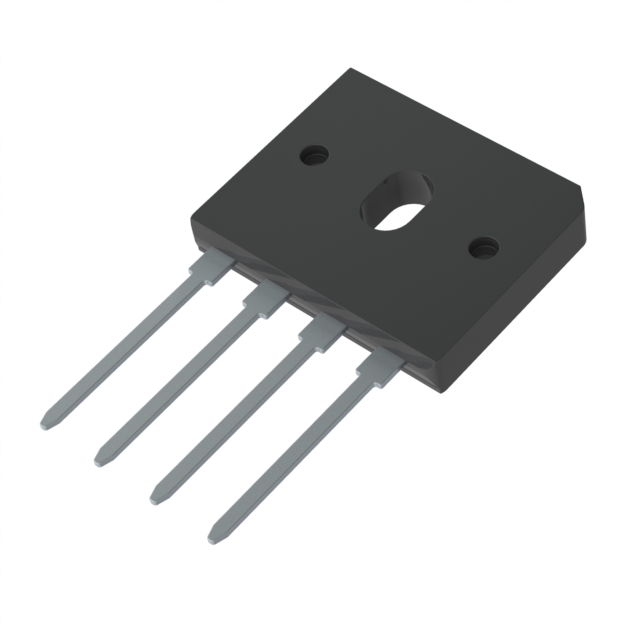
The GBU2510H is a glass passivated bridge rectifier manufactured by Panjit International Inc. It features a GBU-2 package and supports a maximum repetitive peak reverse voltage of 1000 V with a maximum average forward current of 25 A. The device exhibits a peak forward surge current capability of 350 A at 25 °C and 700 A for 1.0 ms pulses. Electrical characteristics include a typical junction capacitance of 100 pF measured at 1 MHz, a maximum forward voltage drop of 1.05 V at 12.5 A, and a reverse leakage current of 5 µA at 25 °C. The component operates within a temperature range of -55 °C to 175 °C.
Verify the specific ordering suffix T0_00601 against official distributor catalogs to confirm tube packaging quantities and marking codes. Ensure the procurement documentation explicitly references the GBU-2 package type and glass passivation technology. Confirm that the delivered components match the Panjit datasheet specifications for electrical parameters and mechanical dimensions before integration into production lines.
Select this component when designing circuits requiring 1000 V blocking voltage and 25 A continuous current handling in a GBU-2 form factor. Evaluate thermal resistance requirements based on heatsink availability, as the device supports up to 25 A with cooling but drops to 4 A without one. Consider the 175 °C maximum junction temperature rating for high-temperature environments and verify compatibility with MIL-STD-750 soldering methods for terminal attachment.
This part belongs to the GBU series of bridge rectifiers from Panjit International Inc., designed for general-purpose high-current rectification. The GBU-2 package provides an integrally molded heatsink structure for efficient thermal dissipation. It serves as a robust solution for AC-to-DC conversion in power supply designs where space constraints and thermal management are critical factors for system reliability.
Cross-reference with other GBU-2 packaged bridge rectifiers offering 1000 V and 25 A ratings. Verify pinout compatibility and physical dimensions to ensure direct replacement feasibility. Check if alternative manufacturers offer equivalent thermal resistance values and forward voltage characteristics to maintain circuit performance integrity.
 GBU2510H_T0_00601

The activity of extra discounts on wholesale prices is in full swing…
Please fill in your contact information and we will send you the latest wholesale price list.