ChipApex | Global Electronic Components Supplier

SEARCH
Search Product
Search Post
— IC芯片 | 连接器 | 传感器 | 被动器件 —
Search productSearch post
— IC芯片 | 连接器 | 传感器 | 被动器件 —
Consult the customer manager about the wholesale price.
consultation hotline:86-132-6715-2157
email:[email protected]
Contact the product manager for consultation. One-stop consultation is available.
Do you want a lower wholesale price? Please send us your inquiry and we will reply immediately.
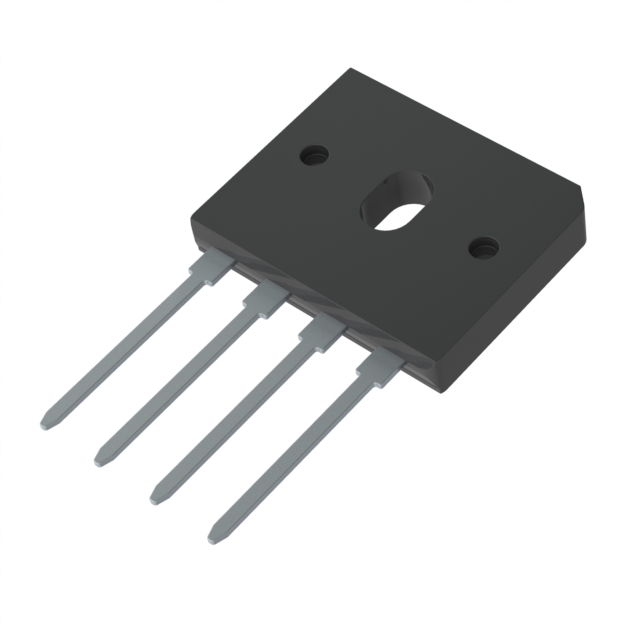
The GBU3510 is a glass passivated bridge rectifier from Panjit International Inc., housed in the GBU-2 package. It supports a maximum repetitive peak reverse voltage of 1000 V and a maximum average forward current of 35 A with a heatsink. The device features a peak forward surge current rating of 400 A at 8.3 ms and 800 A at 1.0 ms. Electrical characteristics include a maximum forward voltage of 1.1 V at 17.5 A and a maximum reverse current of 5 uA at 25°C. Thermal resistance values are 6°C/W (junction-to-ambient) and 2°C/W (junction-to-case). Operating junction and storage temperatures range from -55°C to 150°C.
Verify the specific ordering suffix against official documentation, as variations may exist within the GBU series. Confirm compliance with environmental directives such as RoHS 2.0 and IEC 61249 halogen-free standards during sourcing. Ensure the supplier provides valid UL recognition file numbers for regulatory adherence. Cross-reference datasheet revisions to guarantee compatibility with current design specifications.
Select this component for designs requiring 1000 V blocking capability and 35 A continuous current handling. Evaluate thermal management strategies based on the specified thermal resistance values. Consider derating curves for operation above 25°C ambient temperature. Verify package dimensions and mounting torque requirements for PCB integration. Assess surge current ratings against potential transient loads in the target application.
This part belongs to the GBU-2 series of glass passivated bridge rectifiers manufactured by Panjit International Inc. The series is designed for general-purpose rectification in medium to high-power applications. The GBU3510 specifically targets 1000 V reverse voltage environments. It utilizes standard through-hole mounting techniques compatible with automated assembly processes.
Direct substitutes must match the 1000 V reverse voltage, 35 A current rating, and GBU-2 package footprint. Verify equivalent thermal resistance and forward voltage characteristics. Ensure replacement components maintain UL recognition and environmental compliance standards.
 GBU3510_T0_00601

The activity of extra discounts on wholesale prices is in full swing…
Please fill in your contact information and we will send you the latest wholesale price list.