ChipApex | Global Electronic Components Supplier

SEARCH
Search Product
Search Post
— IC芯片 | 连接器 | 传感器 | 被动器件 —
Search productSearch post
— IC芯片 | 连接器 | 传感器 | 被动器件 —
Consult the customer manager about the wholesale price.
consultation hotline:86-132-6715-2157
email:[email protected]
Contact the product manager for consultation. One-stop consultation is available.
Do you want a lower wholesale price? Please send us your inquiry and we will reply immediately.
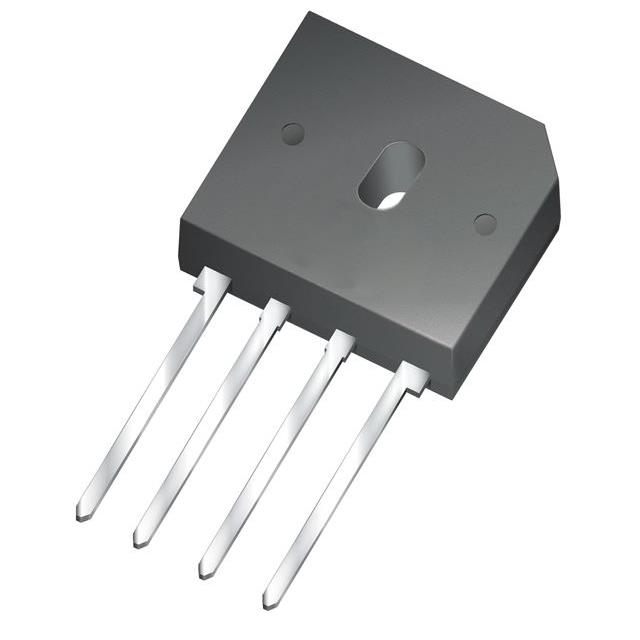
The GBU603D2G is a single-phase bridge rectifier manufactured by Taiwan Semiconductor, designed for general-purpose applications. It features an inline bridge configuration housed in a GBU-4 package with through-hole solder pin termination. The device supports a maximum average forward rectified current of 6 A and withstands a peak repetitive reverse voltage of 200 V. Key electrical characteristics include a maximum forward voltage drop of 1.1 V at rated current and a low reverse leakage current of 5 µA. It is qualified under the AEC-Q101 standard for automotive reliability and operates within a temperature range of -55 °C to +150 °C junction temperature.
Verify component authenticity directly with Taiwan Semiconductor or authorized distributors. Confirm that the specific suffix indicates the correct packaging format and compliance status. Ensure the procurement channel provides valid traceability documentation. Cross-reference the manufacturer part number with official datasheets to confirm technical specifications match design requirements before ordering.
Select this component when a 6 A current rating and 200 V reverse voltage are required for space-constrained through-hole designs. The GBU-4 package offers a compact footprint compared to larger bridge rectifiers. Consider the AEC-Q101 qualification if the application involves automotive or high-reliability industrial environments. Evaluate the 1.1 V forward voltage drop for efficiency calculations in low-voltage output applications.
This component belongs to the GBU series of single-phase bridge rectifiers from Taiwan Semiconductor. The series is characterized by its inline bridge structure and robust construction for general-purpose rectification. The GBU603 variant specifically denotes the 6 A current and 200 V voltage ratings within this product family line.
Direct replacements must match the 6 A current, 200 V voltage, and GBU-4 package dimensions. Verify that alternative parts meet AEC-Q101 requirements if automotive qualification is necessary. Check forward voltage and reverse leakage specifications to ensure equivalent thermal and electrical performance in the target circuit.
 GBU603 D2G

The activity of extra discounts on wholesale prices is in full swing…
Please fill in your contact information and we will send you the latest wholesale price list.