ChipApex | Global Electronic Components Supplier

SEARCH
Search Product
Search Post
— IC芯片 | 连接器 | 传感器 | 被动器件 —
Search productSearch post
— IC芯片 | 连接器 | 传感器 | 被动器件 —
Consult the customer manager about the wholesale price.
consultation hotline:86-132-6715-2157
email:[email protected]
Contact the product manager for consultation. One-stop consultation is available.
Do you want a lower wholesale price? Please send us your inquiry and we will reply immediately.
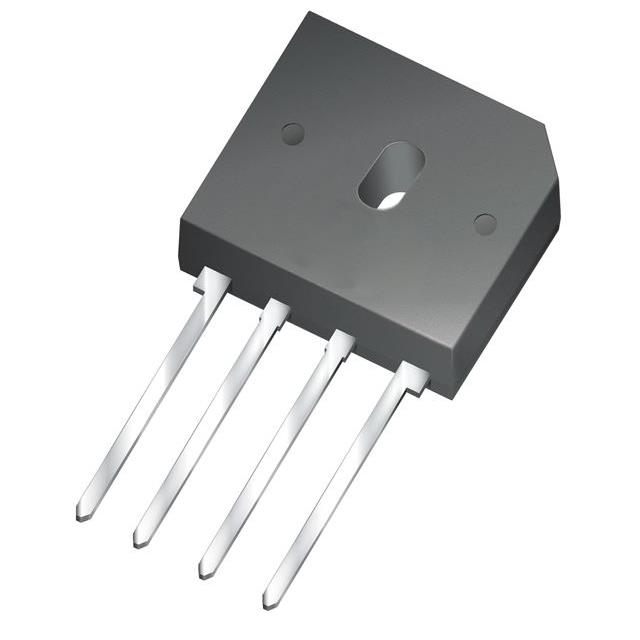
The GBU807 is a single-phase glass-passivated bridge rectifier manufactured by Taiwan Semiconductor Corporation. It features an 8.0 A average forward current rating and supports peak reverse voltages up to 1000 V. The device utilizes a GBU-4 through-hole package with solder pin termination, measuring 22.3 mm in length, 18.8 mm in height, and 3.56 mm in width. Electrical characteristics include a maximum forward voltage of 1.1 V at rated current, a reverse leakage current of 5 µA, and a surge current capability of 200 A. It operates within a temperature range of -65 °C to +200 °C.
Verify component authenticity by cross-referencing the manufacturer marking with official datasheet specifications. Confirm RoHS compliance status and specific suffix codes directly with authorized distributors or the manufacturer prior to ordering. Ensure storage conditions align with semiconductor handling guidelines to maintain performance integrity.
Select this component when designing circuits requiring an 8 A continuous current capacity with reverse voltage ratings up to 1000 V. The GBU-4 package is appropriate for applications needing robust thermal dissipation and mechanical stability on PCBs. Verify that the operating environment does not exceed the specified maximum junction temperature limits during peak load conditions.
This part belongs to the GBU series of single-phase bridge rectifiers from Taiwan Semiconductor. The series covers various voltage ratings from 50 V to 1000 V while maintaining a consistent 8 A current rating and GBU-4 package form factor. This standardization allows for flexible design choices across different voltage requirements without changing the physical footprint.
Compatible alternatives include the GBU806HD2 (800 V rating) or other GBU80x series variants from Taiwan Semiconductor. Cross-manufacturer equivalents such as KBPC800G may be considered if pinout and electrical parameters match exactly. Always verify thermal resistance and package dimensions before substitution.
 GBU807

The activity of extra discounts on wholesale prices is in full swing…
Please fill in your contact information and we will send you the latest wholesale price list.