ChipApex | Global Electronic Components Supplier

SEARCH
Search Product
Search Post
— IC芯片 | 连接器 | 传感器 | 被动器件 —
Search productSearch post
— IC芯片 | 连接器 | 传感器 | 被动器件 —
Consult the customer manager about the wholesale price.
consultation hotline:86-132-6715-2157
email:[email protected]
Contact the product manager for consultation. One-stop consultation is available.
Do you want a lower wholesale price? Please send us your inquiry and we will reply immediately.
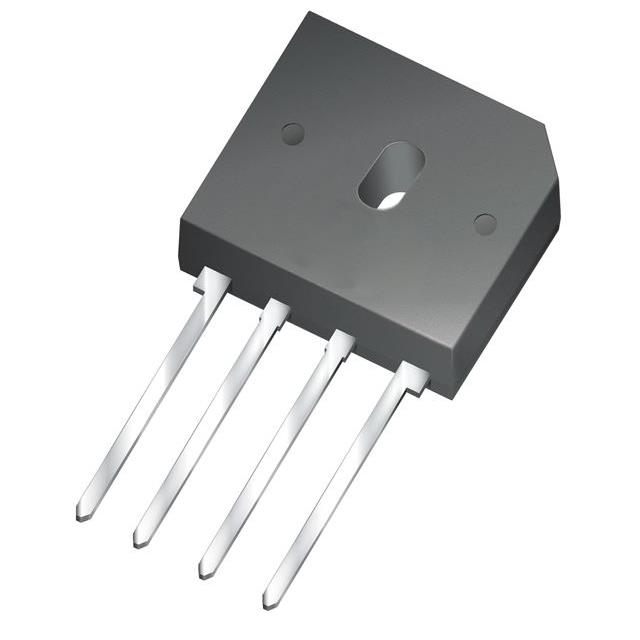
The GBU807H is a single-phase bridge rectifier manufactured by Taiwan Semiconductor Corporation. It utilizes glass passivation for the silicon chips and is housed in a GBU-4 plastic package designed for through-hole mounting. The device supports a maximum average forward rectified current of 8.0 Amperes and offers a peak repetitive reverse voltage rating of 700 Volts. Key electrical characteristics include a maximum non-repetitive peak surge current of 200 Amperes and a maximum DC blocking voltage of 700 Volts. The component is engineered for reliable operation with a flammability classification of 94V-0.
Verify the specific suffix 'H' against official Taiwan Semiconductor documentation, as standard listings often reference GBU807 without this suffix. Confirm RoHS compliance status and exact pinout configuration via the manufacturer's datasheet before ordering. Ensure the supplier provides genuine components from authorized channels to avoid counterfeit risks associated with high-demand power rectifiers.
Select the GBU807H when an 8A current rating and 700V reverse voltage are required in a GBU-4 package. Compare thermal resistance values against system heat dissipation capabilities. Verify that the forward voltage drop at full load aligns with efficiency targets. Ensure the physical footprint matches the PCB layout constraints for through-hole assembly.
This component belongs to the GBU series of single-phase bridge rectifiers from Taiwan Semiconductor. The series covers voltage ratings from 50V to 1000V with an 8A current capacity. The GBU807 variant specifically addresses applications needing 700V blocking capability. The family shares common mechanical dimensions and mounting styles for interchangeability within design limits.
Direct substitutes include other manufacturers' GBU807 equivalents such as those from Compact Technology Corp or Shenzhen Luguang Electronics. Ensure replacement parts maintain the same 8A current rating, 700V reverse voltage, and GBU-4 package type. Verify that alternative sources offer comparable surge current ratings and thermal performance.
 GBU807H

The activity of extra discounts on wholesale prices is in full swing…
Please fill in your contact information and we will send you the latest wholesale price list.