 ChipApex | Global Electronic Components Supplier

SEARCH
Search Product
Search Post
— IC芯片 | 连接器 | 传感器 | 被动器件 —
Search productSearch post
— IC芯片 | 连接器 | 传感器 | 被动器件 —
Consult the customer manager about the wholesale price.
consultation hotline:86-132-6715-2157
email:[email protected]
Contact the product manager for consultation. One-stop consultation is available.
Do you want a lower wholesale price? Please send us your inquiry and we will reply immediately.
The GBU8JL-5300E3/51 is a single-phase standard bridge rectifier manufactured by Vishay General Semiconductor - Diodes Division. It features a 600 V reverse repetitive voltage (Vrrm) rating and an average forward rectified current (Io) of 3.9 A. The device utilizes the GBU through-hole package with four pins, designed for board mounting. Key electrical parameters include a peak non-repetitive forward surge current (Ifsm) of 200 A, a maximum peak forward voltage (Vf) of 1 V, and a peak reverse leakage current (Ir) of 5 μA at 600 V. The operating junction temperature range spans from -55°C to 150°C.
Verify the specific suffix '5300' against official Vishay documentation to confirm availability and exact specifications, as this variant may differ from standard GBU8J models. Ensure compatibility with required PCB footprint and thermal management solutions. Cross-reference datasheets for any recent product change notices or obsolescence alerts before finalizing procurement plans.
Select this component when a 600 V rating and approximately 4 A continuous current are required in a GBU package. Consider the 200 A surge capacity for inrush current handling. Compare Vf characteristics against system efficiency requirements. Verify that the through-hole mounting style aligns with the target assembly process and mechanical constraints.
This part belongs to the Vishay GBU8 series of bridge rectifiers, which are widely used in industrial and consumer electronics. The GBU package offers a balance of current handling and size. The 'J' suffix typically denotes a 600 V rating within this family. The 'E3' indicates RoHS compliance and lead-free construction, adhering to modern environmental standards for semiconductor components.
Direct parameter-equivalent replacements may include other Vishay GBU8J variants such as GBU8J-E3/51 if current ratings match. Verify pinout compatibility and thermal performance. Alternative manufacturers offering similar GBU-form-factor rectifiers should be evaluated for electrical equivalence and mechanical fit.
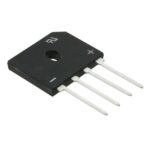 GBU8JL-5300E3/51

The activity of extra discounts on wholesale prices is in full swing…
Please fill in your contact information and we will send you the latest wholesale price list.





