 ChipApex | Global Electronic Components Supplier
SEARCH
Search Product
Search Post
— IC芯片 | 连接器 | 传感器 | 被动器件 —
Search productSearch post
— IC芯片 | 连接器 | 传感器 | 被动器件 —
Consult the customer manager about the wholesale price.
consultation hotline:86-132-6715-2157
email:[email protected]
Contact the product manager for consultation. One-stop consultation is available.
Do you want a lower wholesale price? Please send us your inquiry and we will reply immediately.
The GP3D010A065A is a Silicon Carbide Schottky diode manufactured by SemiQ, designed for high-efficiency power conversion. It features a 650 V repetitive peak reverse voltage and a continuous forward current of 10 A in a TO-220-2 through-hole package. Key electrical parameters include a maximum forward voltage of 1.9 V at rated current, a low reverse leakage current of 1 µA, and a power dissipation rating of 104 W. The device operates within a junction temperature range of -55°C to +175°C, ensuring robust performance in demanding thermal environments.
Verify the specific suffix designation against the manufacturer's latest datasheet to confirm pinout compatibility and exact electrical tolerances. Ensure the procurement channel provides original manufacturer documentation to validate authenticity. Cross-reference the package type and thermal characteristics with your PCB layout requirements before finalizing orders.
Select this component when designing circuits requiring low reverse leakage and fast switching speeds at 650 V ratings. The TO-220-2 package is suitable for moderate power levels where through-hole mounting is preferred for mechanical stability. Evaluate thermal management needs based on the 104 W dissipation rating and ambient operating conditions.
This part belongs to SemiQ's GP3D series of Silicon Carbide Schottky diodes. The series offers various voltage and current ratings packaged in standard through-hole formats like TO-220 and TO-247. These components are engineered to replace silicon PN junction diodes in high-performance power electronics, providing improved energy efficiency and reduced system size.
Direct replacements must match the 650 V rating, 10 A current capacity, and TO-220-2 package. Verify that substitute parts maintain comparable forward voltage and reverse leakage specifications to ensure circuit performance parity.
The maximum operating junction temperature is +175°C.
No, as a Schottky diode, it has negligible reverse recovery charge, which minimizes switching losses.
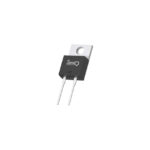 GP3D010A065A
The activity of extra discounts on wholesale prices is in full swing…
Please fill in your contact information and we will send you the latest wholesale price list.






