 ChipApex | Global Electronic Components Supplier
SEARCH
Search Product
Search Post
— IC芯片 | 连接器 | 传感器 | 被动器件 —
Search productSearch post
— IC芯片 | 连接器 | 传感器 | 被动器件 —
Consult the customer manager about the wholesale price.
consultation hotline:86-132-6715-2157
email:[email protected]
Contact the product manager for consultation. One-stop consultation is available.
Do you want a lower wholesale price? Please send us your inquiry and we will reply immediately.
The SemiQ GP3D012A065A is a silicon carbide (SiC) Schottky diode designed for high-efficiency power conversion. It features a 650 V reverse voltage rating and supports an average forward current of 12 A in a TO-220-2L package. The device exhibits a typical forward voltage of 1.5 V at rated current, with a maximum non-repetitive peak forward surge current of 100 A. Operating temperatures range from -55°C to +175°C, ensuring reliability in demanding thermal environments.
Verify the specific suffix 'A' against official datasheets to confirm pinout and electrical tolerances, as variations may exist within the product family. Ensure the TO-220-2L package dimensions match your PCB footprint requirements. Confirm RoHS compliance status through the manufacturer's latest documentation before finalizing procurement specifications.
Select this component when designing systems requiring low reverse recovery charge and high-temperature stability. The 12 A rating suits moderate power applications where efficiency is critical. Compare the 1.5 V forward voltage against alternative SiC or silicon devices to evaluate conduction loss trade-offs. Ensure the 650 V breakdown voltage provides adequate margin for your circuit's peak reverse voltage conditions.
This part belongs to SemiQ's Gen 3 silicon carbide diode portfolio, which focuses on optimizing the balance between forward voltage and switching performance. The GP3D series utilizes advanced SiC technology to replace traditional silicon fast-recovery diodes, offering improved system efficiency in compact power modules.
Direct substitutes include other 650V 12A SiC Schottky diodes in TO-220 packages from manufacturers like Wolfspeed or ROHM. Verify that replacement parts meet the same 175°C operating temperature rating and have comparable forward voltage characteristics to maintain thermal design integrity.
The maximum operating temperature is specified as +175°C.
As a Schottky diode, it has negligible reverse recovery charge, resulting in minimal switching losses.
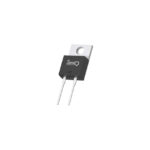 GP3D012A065A
The activity of extra discounts on wholesale prices is in full swing…
Please fill in your contact information and we will send you the latest wholesale price list.






