 ChipApex | Global Electronic Components Supplier

SEARCH
Search Product
Search Post
— IC芯片 | 连接器 | 传感器 | 被动器件 —
Search productSearch post
— IC芯片 | 连接器 | 传感器 | 被动器件 —
Consult the customer manager about the wholesale price.
consultation hotline:86-132-6715-2157
email:[email protected]
Contact the product manager for consultation. One-stop consultation is available.
Do you want a lower wholesale price? Please send us your inquiry and we will reply immediately.
The GSIB1520-E3/45 is a single-phase bridge rectifier from Vishay General Semiconductor, utilizing the GSIB-5S through-hole package. It features a maximum repetitive peak reverse voltage (VRRM) of 200 V and supports a maximum average forward rectified output current of 15 A at a case temperature of 107 °C, or 3.5 A at an ambient temperature of 25 °C without a heatsink. The device handles a peak forward surge current (IFSM) of 300 A and exhibits a maximum instantaneous forward voltage drop of 0.95 V at 7.5 A. Operating junction temperatures range from -55 °C to +150 °C.
Verify component authenticity by checking for the Vishay marking on the plastic body and confirming the E3 suffix indicates lead-free compliance. Ensure the ordering code matches the specific voltage rating required for the circuit design. Cross-reference the document number 88644 to access the latest official datasheet specifications before finalizing procurement orders.
Select this component when a 200 V blocking voltage is sufficient for the AC input line. Consider the thermal environment carefully; the 15 A rating requires a heatsink at 107 °C case temperature, while free-air operation limits current to 3.5 A. Verify that the PCB layout accommodates the GSIB-5S footprint and allows for the recommended mounting torque of 5.7 cm-kg.
This part belongs to the GSIB15xx series of single-phase single in-line bridge rectifiers manufactured by Vishay General Semiconductor. The series includes variants with different voltage ratings such as GSIB1540, GSIB1560, and GSIB1580, all sharing the same physical GSIB-5S package dimensions and mechanical characteristics.
Direct substitutes within the same series include GSIB1540-E3/45, GSIB1560-E3/45, and GSIB1580-E3/45. These alternatives offer higher voltage ratings of 400 V, 600 V, and 800 V respectively, while maintaining identical current handling capabilities and package styles.
The maximum DC blocking voltage is 200 V.
Yes, the base part number ending in -E3 denotes RoHS-compliant, commercial grade material.
The typical thermal resistance RθJA is 22 °C/W when units are mounted on a PCB without a heatsink.
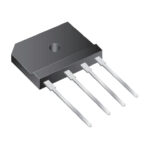 GSIB1520-E3/45

The activity of extra discounts on wholesale prices is in full swing…
Please fill in your contact information and we will send you the latest wholesale price list.





