 ChipApex | Global Electronic Components Supplier

SEARCH
Search Product
Search Post
— IC芯片 | 连接器 | 传感器 | 被动器件 —
Search productSearch post
— IC芯片 | 连接器 | 传感器 | 被动器件 —
Consult the customer manager about the wholesale price.
consultation hotline:86-132-6715-2157
email:[email protected]
Contact the product manager for consultation. One-stop consultation is available.
Do you want a lower wholesale price? Please send us your inquiry and we will reply immediately.
The GSIB1560-E3/45 is a single-phase bridge rectifier from Vishay General Semiconductor, designed for high-performance AC-to-DC conversion. It features a maximum average forward rectified output current of 15 A and a peak repetitive reverse voltage of 600 V. The device supports a peak forward surge current of 300 A and operates within a junction temperature range of -55 °C to +150 °C. Packaged in the thin GSIB-5S through-hole format with matte tin-plated leads, it offers a typical thermal resistance of 22 °C/W when mounted on a PCB without a heatsink.
Verify component authenticity by checking for the Vishay marking code and E3 suffix indicating RoHS compliance. Confirm the specific GSIB1560 variant matches the required 600 V rating. Ensure packaging integrity remains intact during transit to prevent lead damage. Validate that the delivery mode aligns with project requirements before finalizing orders.
Select this component when a 600 V blocking capability is necessary alongside a 15 A continuous current rating. The GSIB-5S package is suitable for applications requiring compact through-hole integration. Evaluate thermal management needs based on the 22 °C/W junction-to-ambient resistance if no external heatsink is utilized. Consider the 300 A surge capacity for systems experiencing high inrush currents.
This part belongs to the GSIB15 series of single-phase bridge rectifiers manufactured by Vishay General Semiconductor. The series includes variants with different voltage ratings such as 200 V, 400 V, and 800 V. All members share the same GSIB-5S mechanical footprint and general electrical characteristics, differing primarily in their maximum repetitive peak reverse voltage specifications.
Direct substitutes include other Vishay GSIB15 series parts like GSIB1540 or GSIB1580 if voltage ratings differ. Cross-brand replacements must match the 15 A current, 600 V voltage, and GSIB-5S package dimensions. Verify that alternative components meet the same UL recognition file number E54214 requirements.
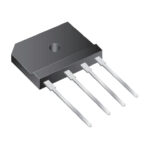 GSIB1560-E3/45

The activity of extra discounts on wholesale prices is in full swing…
Please fill in your contact information and we will send you the latest wholesale price list.






