 ChipApex | Global Electronic Components Supplier

SEARCH
Search Product
Search Post
— IC芯片 | 连接器 | 传感器 | 被动器件 —
Search productSearch post
— IC芯片 | 连接器 | 传感器 | 被动器件 —
Consult the customer manager about the wholesale price.
consultation hotline:86-132-6715-2157
email:[email protected]
Contact the product manager for consultation. One-stop consultation is available.
Do you want a lower wholesale price? Please send us your inquiry and we will reply immediately.
The GSIB2520N is a single-phase single in-line bridge rectifier manufactured by Vishay General Semiconductor. It features a maximum average forward rectified output current of 25 A and a maximum repetitive peak reverse voltage of 200 V. The device utilizes a glass passivated chip junction within a thin GSIB-5S package, providing high surge current capability with an IFSM rating of 350 A. Electrical characteristics include a maximum instantaneous forward voltage drop of 1.0 V at 12.5 A and a maximum DC reverse current of 10 μA at rated blocking voltage. The component supports an operating junction temperature range from -55 °C to +150 °C.
Verify the specific part number suffix against official documentation to confirm compliance status. The M3 suffix indicates halogen-free, RoHS-compliant, commercial grade material categorization. Ensure that procurement specifications align with the required thermal management conditions, as current ratings vary significantly between heatsink-mounted and PCB-mounted configurations.
Select the GSIB2520N when a 200 V peak reverse voltage rating is required alongside a 25 A continuous current capacity. Consider the thermal resistance values provided for both case-mounted and PCB-mounted scenarios to ensure adequate heat dissipation. Verify that the application environment remains within the specified -55 °C to +150 °C operating junction temperature range.
This component belongs to the GSIB series of single-phase single in-line bridge rectifiers, which also includes variants with higher voltage ratings such as the GSIB2540N, GSIB2560N, and GSIB2580N. All models in this family share the same GSIB-5S package style and similar electrical characteristics regarding current handling and thermal performance, differing primarily in their maximum repetitive peak reverse voltage capabilities.
Direct replacements within the same series include the GSIB2540N (400 V), GSIB2560N (600 V), and GSIB2580N (800 V). These parts maintain identical current ratings and package dimensions, allowing for pin-compatible substitution where higher voltage margins are beneficial or required by the circuit design.
The maximum thermal resistance from junction to ambient (RθJA) is 22 °C/W when the unit is mounted on a PCB without a heatsink.
The maximum average forward rectified output current is 25 A when the case is mounted on an aluminum plate heatsink at 98 °C, but it drops to 3.5 A when mounted on a PCB at 25 °C ambient temperature.
Yes, the device features a high case dielectric strength of 2500 V RMS, making it suitable for applications requiring robust insulation capabilities.
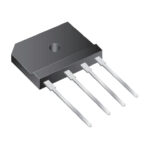 GSIB2520N-M3/45

The activity of extra discounts on wholesale prices is in full swing…
Please fill in your contact information and we will send you the latest wholesale price list.





